Private Equity To Be Blocked From Buying Homes?

The short version
- Authored by Matt Stoller via BIG , Based on a vote last week, it seems very likely Congress will ban corporate ownership of most existing single family homes.
- "People live in homes," said Trump in January .
- "Not corporations." While Trump has sometimes talked a big game on constraining Wall Street, he generally hasn't followed through.
- And somehow, a very corporate-friendly legislature came through as well.
- It's almost impossible to believe, but here's the relevant provision in the 21st Century ROAD to Housing Act that passed the U.S.
The story
Authored by Matt Stoller via BIG,
Based on a vote last week, it seems very likely Congress will ban corporate ownership of most existing single family homes. "People live in homes," said Trump in January. "Not corporations." While Trump has sometimes talked a big game on constraining Wall Street, he generally hasn't followed through. In this case, though, he did. And somehow, a very corporate-friendly legislature came through as well.
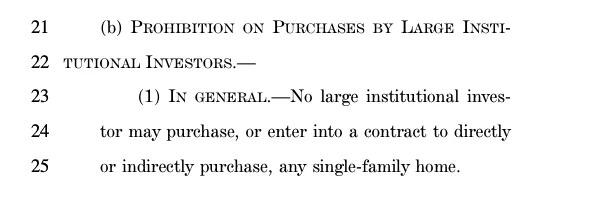
It's almost impossible to believe, but here's the relevant provision in the 21st Century ROAD to Housing Act that passed the U.S. House of Representatives on Wednesday, by a 396-13 margin.
And here's the White House's statement supporting the bill.
As called for during the State of the Union, this legislation includes the President's signature priority: banning large institutional investor purchases of single-family homes. Section 1001 delivers a framework that addresses Wall Street's dominance in the single family housing market and protects Main Street homebuyers.
And the House followed the Senate, which in March passed an even more stringent ban, led by Senator Elizabeth Warren. There are some important caveats here, which I'll go into. But it's still a remarkable accomplishment, and a shockingly weird Warren-Trump alliance, that no one would have predicted a year ago.
So what happened?
I wrote up the full account two months ago, when the Senate acted. The short story is that voters were mad about high housing costs in 2024, and voted against the Democrats as a result. In January, Trump realized voters were now mad at him for high housing costs. And so he wanted to do something. But what could he do? He was trying to impose his will on the Federal Reserve, which could lower rates for homeowners. But that wasn't working out because he couldn't get the Supreme Court or the Senate to go along.
And beyond that, mortgage rates aren't the only driver of costs. So what hiking housing prices? There is a split in both parties over that question. One theory comes from a group of Wall Street-friendly liberals and libertarians, known as the "Abundance movement," who argue the problem is that we're not friendly enough to capital, and the solution is to remove zoning limitations. Yet despite the removal of many such limitations in states like California, there hasn't been a spurt of homebuilding.
A different theory comes from anti-monopolists, who believe that the consolidation of financing power and homebuilding capacity led to supply restrictions. That group argued that Wall Street cash was pouring into single family housing as an asset class, driving up prices for ordinary people. And those buyers, as corporate landlords, didn't serve renters particularly well. There is substantial evidence behind this theory.
Institutional ownership is regionally concentrated, with investors buying up properties in particular cities. In Atlanta, for instance, large institutional investors have dominant shares of the market…
In 2024, the Federal Trade Commission under Lina Khan found that Invitation Homes, a spinoff of Blackstone, had engaged in rampant misbehavior. The CEO told one of his subordinates to “juice this hog” and they did so by deceiving renters, unfairly evicting people, charging junk fees, and so forth…
Congressional documents showed that “renters in institutionally-owned SFR homes often experience higher rent increases, inflated fees, and diminishing quality of housing over time.” And Federal Reserve economists wrote a paper observing that such investors “raise rents at 60 percent higher rates than the average increase when first acquiring the property,” and that rents overall go up.
Big builders are now working with Wall Street to construct single family homes that never go on the market, but instead are rented out from the beginning. This "Build to Rent" sector took off, doubling in market share from 2021-2024. And it is now where institutional capital is focused. Build to Rent allows Wall Street to augment an asset class, and it enables control of housing supply to keep prices up.
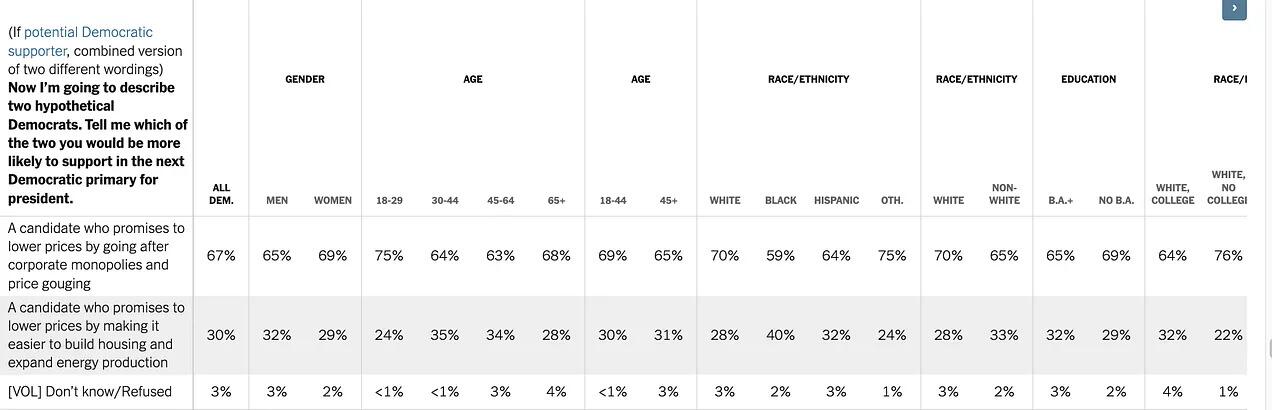
Trump usually has an intuitive understanding of where voters are, even if he often chooses other priorities. And on housing, he got that the public is quite populist. Here’s the New York Times’s latest poll, showing that Democrats by a more than two to one margin blame corporate monopolies over supply restrictions for the price of homes and energy. It’s likely not that different among independents or the GOP.
Trump issued an executive order and a Truth Social post on the need to ban corporate ownership of housing. He even criticized the big homebuilders, saying they were “sitting on 2 Million empty lots, a RECORD.” And he called them similar to the oil cartel OPEC. Here’s what Trump said in his order, and honestly, it would be hard for me to write it any better.
A growing share of single-family homes, often concentrated in certain communities, have been purchased by large Wall Street investors, crowding out families seeking to buy homes. Hardworking young families cannot effectively compete for starter homes with Wall Street firms and their vast resources. Neighborhoods and communities once controlled by middle-class American families are now run by faraway corporate interests. People live in homes, not corporations. My Administration will take decisive action to stop Wall Street from treating America's neighborhoods like a trading floor and empower American families to own their homes.
This policy decision by Trump synced up with a bill that Republican Senator Tim Scott and Democratic Senator Elizabeth Warren had prepared in the Banking Committee to lower housing costs back in July of last year. Their goal was to improve supply, by doing things like encouraging more manufactured housing, speeding up zoning, and providing more public money for homebuilding and cities.
When Trump chimed in with his views, Scott and Warren then included a provision to ban large institutional investors from owning single family homes, setting a limit of 350 homes per investor. They also imposed significant limits on the "Build to Rent" sector. The Scott/Warren bill passed 89-10, an overwhelming majority.
The fly in the ointment was the House of Representatives, notably the Republican Chair of the Financial Services Committee, French Hill. Private equity was pouring in money to help Hill. His goal was to force the Senate to sit down and negotiate something different, removing the institutional ownership caps.
The big question was whether the White House would be able and willing to jam Hill, and force the House to accept the Senate package. It was possible. Trump himself was not particularly focused on housing, as the Iran War, AI, the ballroom, the Federal Reserve and his lawsuit with the IRS were taking up his attention. But if the House Democrats were on board, then the White House could likely swing enough Republican votes to push the Senate bill through.
And that seemed to be doable, even likely. Private equity, especially buying housing, is politically toxic. And the House Democratic lead on the Financial Services Committee is an 87-year old Congresswoman named Maxine Waters, who has traditionally been an assertive liberal icon. So you'd think she'd be supportive, and could cap her long political career with a powerful bill making sure that the American home would be owned by American families.
But Waters, like so many of her generation, just doesn't want to give up power. She's controversial, she's not a good fundraiser, and Democrats are starting to attack the very old leaders who run committees. So instead of shepherding this bill through, she decided to go full pro-industry, and join Hill in opposing the provisions in the bill that would ban corporate ownership. The House majority leader, Hakeem Jeffries, backed her decision, as did much of the "Abundance" world of advocates. The House draft removed the homeownership provisions entirely.
Trump, Warren, and Scott continued to push, and finally they cut a deal with the House. The ban would stay for existing housing stock, but it would not apply if private equity built new housing, aka the "Build to Rent" sector. Corporations that own and rent single family homes would not be forced to sell them, and they can build new ones. But the existing stock of owner-occupied single family homes, roughly 70 million of them, effectively cannot be bought by big business.
There are still some aspects of the bill being negotiated, but in terms of the housing provisions, something akin to what passed the House is likely to be signed into law later this summer. And the legislation, imperfect as it is, will be the most significant housing legislation in decades, and will prevent the acquisition of the existing U.S. housing stock by Wall Street. It will be left to future lawmakers to find ways of letting renters buy out their Build to Rent homes, or further push back institutional capital from owning other parts of the American home. And single family housing isn't enough of a target, one in eight apartments is now owned by private equity.
Still, with this political setup, in this moment, it's a remarkable accomplishment. In some ways, this kind of legislation may have a parallel to Jimmy Carter's deregulatory zeal. Carter wanted to undo FDR's legacy, and fought hard, with a Democratic Congress, to get rid of public utility rules on airlines, banks, telecommunications providers, trucks, and railroads. Torn between the Democratic Party's allegiance to labor and his desire to break that alliance, he was deeply unpopular. But his deregulatory policies stuck. His successor, Ronald Reagan, built on Carter's approach, and it is Reagan, not Carter, who is known as the President that undid the New Deal.
Trump, like Carter, is a fish out of water. Trump's party is not populist, and mostly he has doubled down on support for Wall Street and war. But there are some indications, like this housing bill, that show it's the end for an entire way of doing business. Since Reagan, American policymakers have been aggressive in ensuring that capital can do whatever it seeks in getting the highest return, and the government has sought to turn whatever it can - our houses, our attention, our pain, sports betting - into an asset class for finance. Trump won't end that, just as Carter didn't end the New Deal. But his successor might.
Related Markets
All MarketsMarket data may be delayed. Not financial advice.
How other outlets covered this
Compare allAlto found this story at 2 outlets. Same event, different framing — compare the headlines.
How this story developed
Full timelineAlto has tracked this across 6 days of coverage from 2 outlets.
- Private Equity To Be Blocked From Buying Homes?You are here
Powered by Gab AI
The Story At A Glance
Reading this article now — analysis appears below
💡 AI analysis provides alternative perspectives on current events