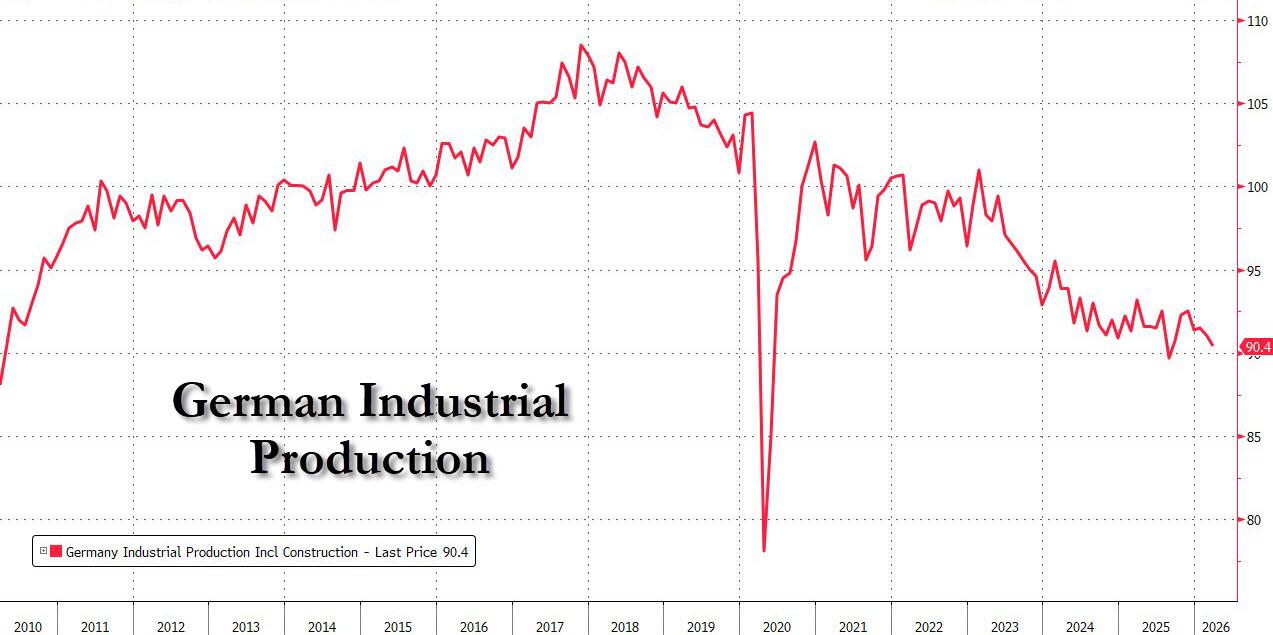
Europe's Deindustrialization vs America's Quiet Investment Boom
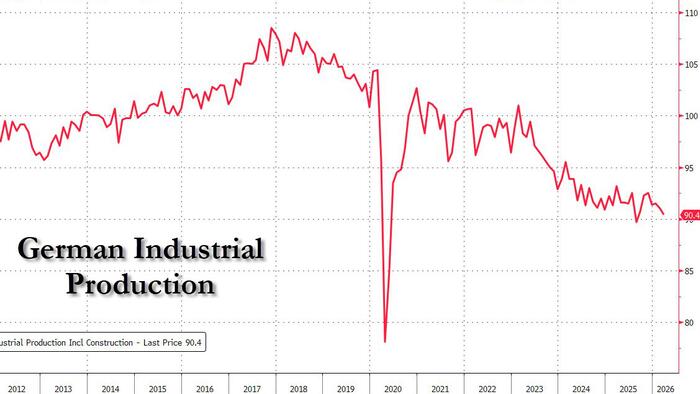
The short version
- Perhaps the chancellor senses that the project of his political generation is entering its final phase.
- Is he aware that the construction of eco-socialism has failed?
- That both his reckless debt policies and Germany’s rapid deindustrialization are consequences of this ideological insanity?
- The fact that Friedrich Merz still found the audacity — despite the catastrophic domestic political and economic situation at home — to publicly accuse U.S.
- President Donald Trump of lacking strategy in the Iran conflict speaks to an almost immeasurable degree of stubborn arrogance and self-delusion.
The story
Submitted by Thomas Kolbe
German Chancellor Friedrich Merz appears disoriented, whiny-apathetic, and remarkably weak in leadership these days. Perhaps the chancellor senses that the project of his political generation is entering its final phase. Is he aware that the construction of eco-socialism has failed? That both his reckless debt policies and Germany’s rapid deindustrialization are consequences of this ideological insanity? The fact that Friedrich Merz still found the audacity — despite the catastrophic domestic political and economic situation at home — to publicly accuse U.S. President Donald Trump of lacking strategy in the Iran conflict speaks to an almost immeasurable degree of stubborn arrogance and self-delusion.
There he was again: the German know-it-all. The type of politician who once lectured Europe’s neighbors over debt problems while failing to compare his own actions with the present condition of his own country.
Merz would have done well to take a look at the American economy and the U.S. labor market before stepping onto such embarrassingly thin rhetorical ice.
In April, the private sector in the United States created 115,000 new jobs. During the opening months of the previous year, another roughly 180,000 jobs had already been added. The U.S. economy has now delivered four strong months in a row, signaling that America is rapidly gaining momentum and — unlike the European economy — is not being derailed by the Iran crisis. These are phenomenal numbers at a time when the world is fighting over scarce capital, know-how, and access to cheap energy resources.
The contrast with Germany could hardly be greater. During the first year of the Merz government, the German public sector was bloated with another 205,000 more-or-less useless jobs, while Donald Trump’s administration cut 300,000 positions from the overstretched state apparatus. During the same period, the American private sector created a net total of more than 750,000 jobs since Trump returned to office, while the German economy eliminated roughly 200,000 positions.
Deregulation, tax cuts, and a fundamental trust in the power of private enterprise across the Atlantic stand in sharp contrast to the sluggish, apathetic-socialist policies of Germany and the European Union — and not in Europe’s favor.
How strongly the American economy is currently developing can be seen in an interesting media phenomenon.
April 29, 2026 - a Wednesday - may one day prove to have been an important turning point. On that day, outgoing Federal Reserve Chairman Jerome Powell appeared before the press for the final time to announce the latest decision on U.S. interest rates. The fact that the Fed left rates unchanged within a range of 3.5 to 3.75 percent came as no surprise. What was striking, however, was the deafening silence inside financial newsrooms, which normally inflate Fed rate decisions into mega-events for the markets and American capitalism itself. This time, the waters remained perfectly calm.
Two developments lie behind the media’s sudden disenchantment with Fed meetings. First, there is the policy of U.S. Treasury Secretary Scott Bessent, who used legislation such as the Genius Act and the Clarity Act to establish the framework for U.S. dollar-based stablecoins, thereby shifting a significant portion of money creation back into the hands of the private banking sector — where it once resided before the creation of the Federal Reserve. Second, the higher policy rates compared to the Eurozone appear to indicate that the U.S. economy is far more robust than European politicians and media figures would like to admit. So the attitude has become: best not to talk about it too much. Otherwise, people might start noticing that the Eurozone economy itself is incapable of surviving positive real interest rates.
Donald Trump’s second presidency has so far delivered 15 months of determined deregulation and a noticeable liberation of the energy sector from the strangling regulatory activism of climate fanatics. Until Trump’s election victory, Washington had been ideologically subordinate to Europe. Back in 2009, the Europeans succeeded in pushing Barack Obama into effectively adopting Europe’s climate policies wholesale in the United States. But the hope that America’s collapse would somehow conceal Europe’s own decline has now evaporated. Behind the strength of the U.S. labor market stand massive forces of private-sector investment.
This is where the ideological divide between the United States and the European Union truly lies. While the EU — driven in large part by German political pressure — has constructed a green redistribution machine that functions as a state within the state, siphoning resources out of productive sectors into the political economy and green transformation bureaucracy, Americans understand something Europeans have forgotten: prosperity is created exclusively through investment in deregulated free markets supported by a functioning price mechanism that reflects relative scarcity.
The effect of Trump’s deregulation wave can only be estimated in rough numbers. In the first quarter of 2026, gross private investment in the United States rose 8.7 percent year-over-year. Investment in equipment and industrial structures increased by 10.4 percent during the same period. These are extraordinary figures at a time when nations are competing aggressively for know-how and resources.
Now compare that to Germany: after years of eco-socialist degrowth policies, overregulation, and energy-policy suicide, Germany’s net investment ratio has slipped into negative territory. In plain English, the German economy is consuming itself. Whatever industrial substance remains is being eaten away and financially leveraged by the state wherever possible. While German industry is tearing down its tents, the United States is writing a genuine reindustrialization story. If the American economy succeeds in maintaining technological leadership over China and secures dominant positions through massive investments by U.S. tech giants in artificial intelligence, robotics, medical technology, aerospace, and mobility, the geopolitical balance of power will shift accordingly.
More than 400 major industrial projects are currently being developed across the United States. These include new nuclear power plants, gigantic data centers, traditional automobile manufacturing facilities, and even aluminum smelters. They are being financed through investments from the Arab states, Japan, and other parts of the world that President Trump brought home from his numerous foreign trips. But domestic demand and America’s internal investment engine are also running at full speed. Something is brewing in the United States — perhaps even a small economic revolution.
From a European perspective, this makes the situation all the more dramatic because the entire ideological failure of globalist politics becomes far more obvious in contrast to the United States.
If ideological hardliners, committed statists, and central planners remain in power in Brussels, Berlin, and Paris, the old continent is likely to sink into a prolonged economic coma — tired, aging, and increasingly weak. Hope for the future, entrepreneurial innovation, and economic dynamism will only return once a younger generation of European free spirits awakens from this comatose winter.
I am convinced that one day a generation of Europeans will clear away the ideological mud of the past with a cold smile on their faces, astonished by the arrogance and ideological blindness of their predecessors. In the end, civilization and humanity’s desire to improve its living conditions will prevail.
* * *
About the author: Thomas Kolbe, a German graduate economist, has worked for over 25 years as a journalist and media producer for clients from various industries and business associations. As a publicist, he focuses on economic processes and observes geopolitical events from the perspective of the capital markets. His publications follow a philosophy that focuses on the individual and their right to self-determination.
How this story developed
Full timelineAlto has tracked this across 2 days of coverage from 1 outlet.
- Europe's Deindustrialization vs America's Quiet Investment BoomYou are here
Powered by Gab AI
The Story At A Glance
Reading this article now — analysis appears below
💡 AI analysis provides alternative perspectives on current events