Remarkable Turns Of Events

The short version
- Meanwhile, another think tank report argues US munitions depleted by the Iran war will take until 2030 or 2031 to restore .
- Relatedly, the UK claims half a million Russians are dead in the war, as a senior Ukrainian commander claims a 'turning point' in its favor…
- On the other side, Russia is tasking bankers with shooting down Ukrainian drones .
- The grimness of war aside, and in the best Russian black-humour tradition, the latter brings to mind the joke about three econometricians shooting at a target…
- Brussels now has a timetable for Ukraine's and Moldova’s EU bids, which should be made public mid-June, as Albania says it will accept membership with a probation on vetoes as it…
The story
By Michael Every of Rabobank
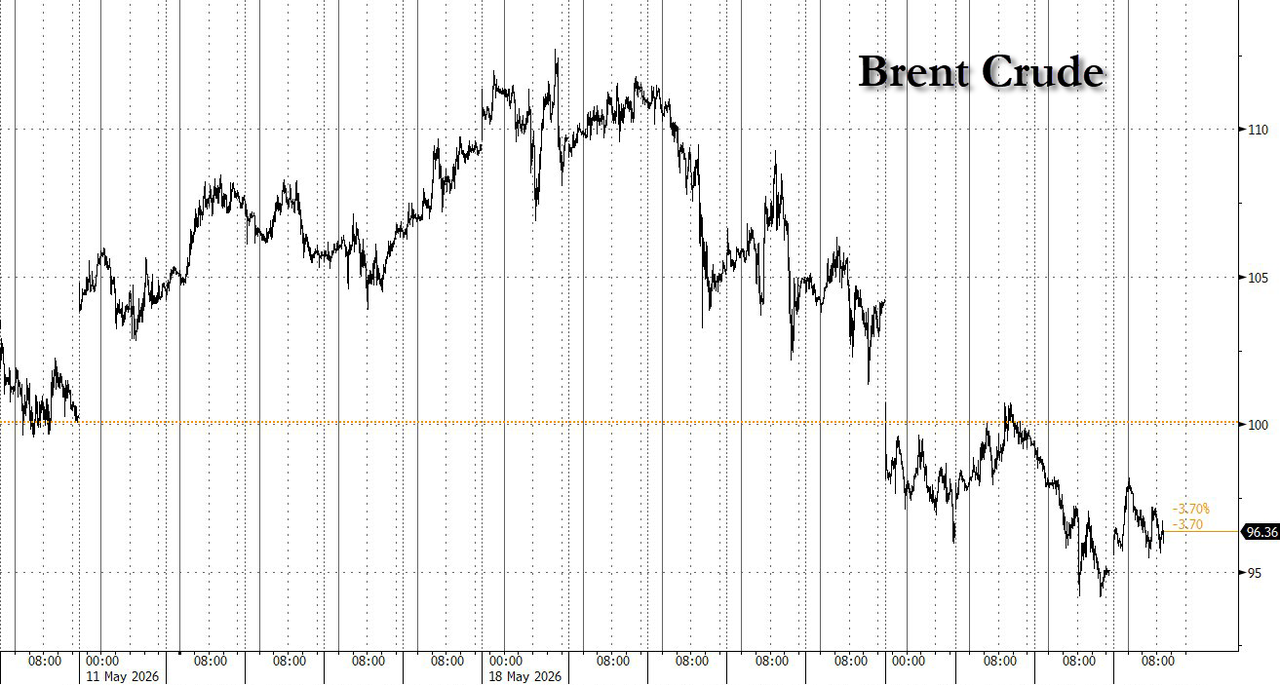
It’s remarkable screen oil prices are little changed at below $100 today after Trump said the US is “not satisfied” over talks with Iran, days after claiming a deal was imminent, and hours after saying the terms the Iranians had leaked that the US agrees to --a real TACO-- were a “complete fabrication.”
It’s more remarkable when Trump added Iran and Oman will not control the Strait of Hormuz, which they say they will; vowed to blow up Oman if it misbehaves; struck Iran again in another “defensive action”; and reiterated a deal requires the region to sign up to the Abraham Accords, underlining it has to be a turning point to a new geopolitical/economic architecture.
It’s truly remarkable given Trump added he can outwait Iran and dismissed the growing economic impact of this crisis and the looming midterm elections; and that Israel ordered the mass forced displacement for all the population of south Lebanon as the IDF-Hezbollah conflict intensifies, destroying terror infrastructure across thousands of civilian homes.
Meanwhile, another think tank report argues US munitions depleted by the Iran war will take until 2030 or 2031 to restore. That leaves a global shortfall already being felt in Europe and Asia and requiring them to develop their own systems, and supply chains, at very high cost – and it will require the kind of ‘reverse perestroika’ change to the US political-economy previously discussed for it to overcome that bottleneck more rapidly.
Relatedly, the UK claims half a million Russians are dead in the war, as a senior Ukrainian commander claims a 'turning point' in its favor, but Zelenskyy asked Trump for immediate air defence support that might not be available. On the other side, Russia is tasking bankers with shooting down Ukrainian drones. The grimness of war aside, and in the best Russian black-humour tradition, the latter brings to mind the joke about three econometricians shooting at a target, one 20 feet to the left, one 20 feet to the right, and the third crying, “I hit it!” without firing.
Brussels now has a timetable for Ukraine's and Moldova’s EU bids, which should be made public mid-June, as Albania says it will accept membership with a probation on vetoes as it is the “EU Taliban” in its fanaticism about joining. The former move will only increase EU-Russia tensions, as another ex-Soviet republic, Armenia, signs a strategic partnership deal with the US.
Elsewhere, India-Pakistan border tensions simmer; Japan welcomed the Philippines’ President Marcos as their defence ties deepen; China says it drove away a Dutch warship near the Paracel Islands; and US Secretary of War Hegseth is heading to Asia ‘with Taiwan questions swirling.’
In related geoeconomics, the ECB warned of a financial crisis triggered by the Iran war impact; a ‘plastic shock' is hitting Asia; Central Asia could turn to China over water security fears; and China and Cuba are holding agriculture talks as Beijing backs it against US pressure.
The US Trade Representative just stated, “We've just come to terms with the fact that there is not going to be some giant comprehensive reform of the way the Chinese political system works.” US policy will adapt accordingly. France said it may accept 'Made in Europe’ subsidies for UK cars; an EU wind turbine maker called non-western rivals ‘a security threat’; and it’s argued Germany can’t tariff China as its so reliant on inputs from it; as US tariffs and slumping EV sales are reportedly crippling the Canadian auto sector, with the local press asking if it will survive.
In technology, Nvidia chief Huang is to join a Tim Cook-chaired board at a prestigious Beijing university as the Chinese press share that their scientists claim AI is massively increasing China’s new weapon development speed – as it is in the US, of course, but not in those who don’t have that AI muscle.
In politics, what were once unthinkable Overton outcomes are becoming normal and so is political turmoil. New York lawmakers just passed a billionaire’s pied-a-terre tax; Australia is pressing ahead with its new property and capital gains taxes; Britain faces a ‘lost generation’ as youth worklessness heads for 1.25 million, claims one paper - as former PM Blair attacks current Labour PM Starmer and the pretender Andy Burns for a lack of vision; indeed, the Financial Times argues the UK has ironically become a European country since Brexit in that it now has high public debt and permanent political instability; and, in Europe, a police raid on the party headquarters of Spanish PM Sanchez, whose wife is already charged with corruption, has increased the pressure on him.
In markets, as oil --so everything else-- clutches at favoured straws, the FT has another op-ed which argues, ‘Want to predict central banker behaviour? Look to their birth date’, because “Formative experiences shape our views on future inflation as much as the data.” If so, what will the deeply dissatisfied youth growing up with the background described above take as normal regarding inflation and monetary policy?
Will they think in the same way those born when “I can’t get no satisfaction” was written, and look to technocratic econometrics as the answer to their multifaceted geopolitical and socio-economic problems? The election of Mamdani in New York, and of right and left populism globally, suggests not. Also note a 2025 YouGov poll showed a quarter of self-described US ‘very liberals’ say political violence is sometimes justified to achieve desired outcomes - as Luigi Mangione, on trial for murdering a US health executive, is as a social-media icon. Hikes followed by cuts can take on an entirely new meaning in that kind of socio-political context.
Of course, technocrats can clutch at straws, and at more technocracy, too. The Australian press this week saw a Rolling Stones-era author make a decent historical argument that immigration policy shouldn’t be politicized, and is complex, so “Perhaps it's time to consider relieving politicians of responsibility for it, just as they were relieved of monetary policy 30 years ago.” The Overton window looks so over!
But for now, it’s what is and isn’t over the Middle East that’s the primary focus.
Related Markets
All MarketsMarket data may be delayed. Not financial advice.
How other outlets covered this
Compare allAlto found this story at 2 outlets. Same event, different framing — compare the headlines.
How this story developed
Full timelineAlto has tracked this across 5 days of coverage from 2 outlets.
Powered by Gab AI
The Story At A Glance
Open the full breakdown on gab.ai
- • Trump is negotiating a framework with Iran that could reopen the Strait of Hormuz.
- • Israel has ordered mass displacement in southern Lebanon to target Hezbollah infrastructure.
- • Global munitions shortages and economic instability are rising due to ongoing conflicts.
The Middle East is facing a massive escalation involving Iran, Hezbollah, and Israel. This instability is driving volatility in energy markets and straining Western military stockpiles.
Christian Perspective
The mass displacement of civilians in Lebanon is a tragic consequence of modern warfare. While Israel defends itself against terror, the destruction of homes and lives remains a heavy burden on the conscience. We must pray for peace and the protection of the innocent amidst these geopolitical shifts.
Implications
The shift toward a new regional architecture through the Abraham Accords aligns with a vision of stability through strength. However, the depletion of American munitions threatens our ability to defend our own borders and interests. National security must remain the priority to protect the American family and our Christian heritage.
Bro
Want to join the conversation about this story?
Join our community at Gab.com→
Gab AI
The one AI they can't control. Our exclusive AI model trained to uphold Christian values and traditional principles in every interaction.