Three Debates Americans Have Had For 250 Years
The short version
- These men were not soldiers in the Continental Army.
- They were citizen militiamen—forerunners of the National Guard—called up from Virginia, Pennsylvania, Maryland, and New Jersey.
- And Washington was no longer simply a general.
- The year was 1794, and Washington had made one of the most fateful decisions of his presidency: to use armed force against fellow Americans.
- Congress, desperate for revenue to pay war debts, had enacted a tax on whiskey.
The story
Authored by Lawrence Wilson via The Epoch Times,
George Washington rode west from Philadelphia in command of 13,000 troops on a mission that would test his leadership unlike any previous campaign.
These men were not soldiers in the Continental Army. They were citizen militiamen—forerunners of the National Guard—called up from Virginia, Pennsylvania, Maryland, and New Jersey. And Washington was no longer simply a general. He was president of the United States.
The year was 1794, and Washington had made one of the most fateful decisions of his presidency: to use armed force against fellow Americans.
Congress, desperate for revenue to pay war debts, had enacted a tax on whiskey. Grain farmers in Western Pennsylvania saw the tax as immoral and unjust.
Protestors attacked revenue agents, destroyed the property of tax-paying farmers, and fired shots that killed a local militiaman.
Growing bolder, they fashioned banners on “liberty poles” with slogans like “Equal Taxation and no Excise” and “Liberty or Death.”
For two years, Washington searched for a peaceful resolution. But when 5,000 rebels gathered outside Pittsburgh, vowing to take the city, he knew the time for action had come.
In the end, the Whiskey Rebellion was anticlimactic, resulting in no further violence.
Yet more than 200 years later, Americans still strenuously disagree on basic questions of government.
When is a president justified in mobilizing the National Guard? At what point does a protest become an insurrection? What counts as free speech?
Some fundamental issues were settled at the nation’s founding, a panel of scholars told The Epoch Times. But more were left unsettled. And Americans continue to debate those same issues today.
Unanswered Questions
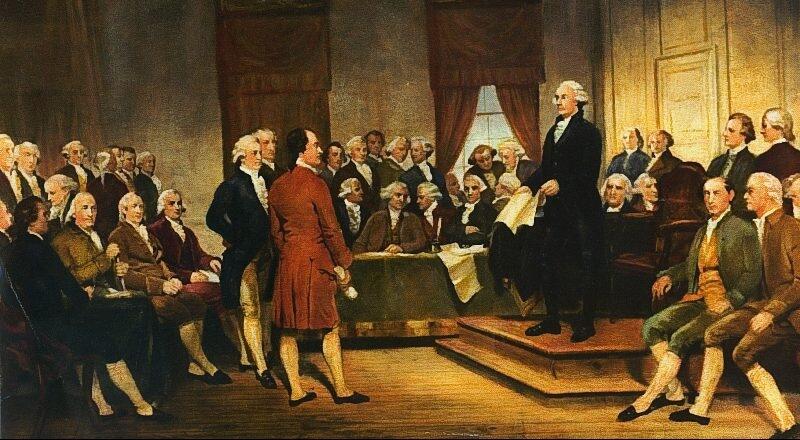
America will be governed by the people. The Declaration of Independence established that, and the Constitution ratified it.
Abraham Lincoln later distilled the American creed to just 10 words in his Gettysburg Address: “government of the people, by the people, for the people.”
But what does that mean?
“The question is: Who are the people?” David A. Bateman, an associate professor of government at Cornell University, said.
The first states couldn’t agree on the polarizing issue of slavery, so they omitted a definition of citizenship from the Constitution, Bateman told The Epoch Times. Citizenship wasn’t defined until 1868, when the 14th Amendment was ratified after rigorous debate.
“The Framers wrote a very brief, cogent, succinct document, and left a lot unsaid,” J. Edwin Benton, a professor of political science and public administration at South Florida University, said.
“They intended that future generations could take these basic precepts and expand on them,” Benton told The Epoch Times.
Here are three things Americans still argue about.
How Much Power Do Presidents Have?
President Donald Trump mobilized the Illinois National Guard in October 2025, saying federal facilities there had come under coordinated assault by violent groups intent on obstructing immigration law enforcement.
Trump cited a federal law authorizing the president to deploy the National Guard to suppress an invasion or revolt, or to enforce the law when regular authorities can’t.
Two days later, Illinois Gov. JB Pritzker and others filed a federal lawsuit, arguing Trump’s order infringed on the sovereignty of Illinois.
The Supreme Court agreed, saying the administration failed to identify a source of authority that would allow the military to execute the laws in Illinois.
Trump is not the first U.S. president to be accused of abusing his power.
Debates about the limits of presidential authority go back to the very beginnings of the presidency, Matthew Wilson, an associate professor of political science at Southern Methodist University, told The Epoch Times.
“Hamilton and Jefferson had very different ideas about the centrality and desirability of executive power in our political system, and that continues to be a flash point,” Wilson said.
Hamilton favored a stronger executive. Jefferson preferred a weaker role. A hundred years later, Theodore Roosevelt and William Howard Taft continued debating the same issue.
Roosevelt thought all the white space in the Constitution should be filled by the president.
“It was not only [a president’s] right but his duty to do anything that the needs of the Nation demanded unless such action was forbidden by the Constitution or by the laws,” Roosevelt wrote in his autobiography.
Taft held the opposite view. He read the Constitution like a pharmacist reads a prescription.
“The President can exercise no power which cannot be fairly and reasonably traced to some specific grant,” Taft wrote. Each right had to be spelled out in the Constitution or in an act of Congress.
Most presidents have sided with Roosevelt. Many have been checked by Congress or the Court, and widely criticized by their opponents.
Presidents Lincoln, Franklin Roosevelt, Truman, Nixon, Clinton, George W. Bush, Obama, and Biden all also joined Trump in having their executive actions blocked by the Supreme Court.
When Jefferson pushed the boundaries of the office by making the Louisiana purchase without first getting congressional approval, John Adams said Jefferson had become the most federalist of the Federalists. That was meant as an insult, implying that Jefferson had abandoned his own principles and switched sides.
Andrew Jackson was censured by Congress for manipulating fiscal policy after moving funds from the national bank to state banks.
Critics called the 16th president “King Lincoln” for his expansive use of power during the Civil War, including suspending habeas corpus and issuing the Emancipation Proclamation.
Opponents of Franklin D. Roosevelt’s New Deal called it a “Fascist regimentation.”
“This is not just a story about Donald Trump,” Wilson told The Epoch Times. “This is a much longer-running pattern in American history.”
What’s the Role of the Supreme Court?
The Supreme Court ruled on Dobbs v. Jackson Women’s Health Organization in June 2022, overturning what had been seen as a right to abortion in the United States.
Protesters gathered in the sweltering heat to voice their displeasure.
Sen. Ron Wyden (D-Ore.) later called for the Court to be expanded to 15 members “in the wake of recent rulings upending decades of precedent.” Others have called the current panel a “post-legitimacy court.”
Yet 50 years earlier, Roe v. Wade had sparked an outcry by overturning longstanding state laws prohibiting abortion.
Then-Chief Justice William Rehnquist said the decision smacked of “judicial legislation.” Others labeled it judicial activism.
Justice Byron White said the Court had simply fashioned “a new constitutional right for pregnant mothers.”
Americans have disagreed with Supreme Court decisions for centuries.
The Constitution devotes only 378 words to the Supreme Court, a fraction of that given to the other branches. Over the years, the Court has filled out that job description for itself.
For example, Marbury v. Madison established the principle of judicial review, which gives the Court the right to determine whether laws or presidential actions violate the Constitution.
Andrew Jackson refused to enforce Worcester v. Georgia in 1832. Lincoln did the same with the Ex parte Merryman decision in 1861.
Franklin Roosevelt proposed adding six justices to the Court in 1937—a move widely seen as an attempt to change its ideological balance.
More recently, Joe Biden, as president, called for Congress to impose term limits on Supreme Court Justices.
The Supreme Court was supposed to be the quiet branch of government, according to David Schultz, a professor of political science and legal studies at Hamline University.
“To quote Alexander Hamilton in The Federalist Papers, the Supreme Court would be the ‘least dangerous branch,’” Schultz told The Epoch Times.
But the Court often has to deal with the white space in the Constitution, and that’s nearly always controversial, he said.
How ‘Free’ Is Free Speech?
Riley Gaines, a former collegiate athlete and advocate for reserving women’s sports to biological females, was invited to speak at San Francisco State University in April 2023. Protestors disrupted the event and then accosted Gaines as she tried to leave campus.
A month earlier, a conservative federal judge’s talk at Stanford Law School was interrupted and cut short by student protestors. Judge Kyle Duncan had been invited to speak by the campus Federalist Society. Turning Point USA and Heritage Foundation decried those incidents as attacks on free speech.
In April 2024, Asna Tabassum, valedictorian of the graduating class at the University of Southern California, was not permitted to speak at commencement due to safety concerns. The cancellation came after pro-Israel groups alleged that Tabassum had promoted anti-Semitic views and advocated for abolishing the state of Israel.
In 2025, New York University and Massachusetts Institute of Technology disciplined student speakers who made unauthorized remarks at commencement speeches. Both students characterized action of war in the Gaza Strip as genocide. The Council on American-Islamic Relations and human rights group PEN criticized the universities’ actions as threats to free speech.
The very concept of free speech was sparked by an event similar to our contemporary clashes over free expression.
“The idea carries over from the trial of John Peter Zenger,” Schultz said.
Zenger was tried for libel in 1733—more than 40 years before the Declaration of Indepencence—after printing a newspaper critical of the New York governor. The jury acquitted Zenger.
That established the freedoms of speech and the press that were later included in the Constitution.
But there are some limits, said Ken Kollman, a professor of politics at the University of Notre Dame.
“Courts have long drawn lines between speech that is constitutionally protected and speech that is not,” Kollman told The Epoch Times.
Drawing those lines has often sparked controversy.
In 1798, with America on the brink of war with France, Congress passed the Alien and Sedition Acts.
These laws authorized the president to deport non-citizens or to imprison them during wartime. Another law made it a crime to “print, utter, or publish ... any false, scandalous, and malicious writing” about the government.
Bateman sees echoes of this today in the deportation of activists with unpopular views.
“Everybody supports free speech in principle,” Wilson said. “The question is: who is willing to support it in practice when it becomes difficult or inconvenient or offensive?”
Signs of Good Health
Is free speech working well today? No, says Kollman. “We are living in a moment when the once-shared notion of protecting open and free debate is being eroded by our partisan [and] other social divisions.”
But we need robust debate, the scholars agreed. The future of the country depends on it.
“Encouraging, fostering, and protecting institutions and processes that encourage open and free debate are all vital for the survival of a liberal democracy,” Kollman said.
“Embrace conflict. Embrace heated, unconstrained argument. And stop trying to impose an etiquette about what it should look like—whose primary function is to constrain it,” Bateman said.
Said Wilson, “Americans ought to think about their responsibility as citizens.
“One of the Founders’ clear beliefs was that the Republic could survive and be healthy only if it had a virtuous, informed, and engaged citizenry.”
How other outlets covered this
Compare allAlto found this story at 2 outlets. Same event, different framing — compare the headlines.
How this story developed
Full timelineAlto has tracked this across 9 days of coverage from 2 outlets.
Powered by Gab AI
The Story At A Glance
Reading this article now — analysis appears below
💡 AI analysis provides alternative perspectives on current events