Rabo On Regime-Change At The Fed: What Warsh Can (And Should) Do First
The short version
- The FOMC could have given him the professional courtesy of allowing him to settle in, but in recent weeks several Committee participants have staked out their position.
- They want to drop the FOMC’s easing bias and instead take a more neutral stance.
- This means it will be more difficult for Warsh to convince the Committee of cutting rates anytime soon.
- The manifesto drew attention for floating ideas well outside the mainstream of monetary policy, including a menu of overhauls whose top-ranked option was “free banking” -…
- The report included a disclaimer that said the ideas shouldn’t be attributed to any individual and instead synthesized the views of a panel of contributors.
The story
The honeymoon period for Warsh is over.
The FOMC could have given him the professional courtesy of allowing him to settle in, but in recent weeks several Committee participants have staked out their position.
They want to drop the FOMC’s easing bias and instead take a more neutral stance.
This means it will be more difficult for Warsh to convince the Committee of cutting rates anytime soon.
Against that internal pressure, WSJ's Fed whisperer, Nick Timaraos reports that Warsh has tapped two outside associates to advise him while he settles into the job, one of whom previously helped write a conservative blueprint that recommended a radical restructuring of the central bank.
The manifesto drew attention for floating ideas well outside the mainstream of monetary policy, including a menu of overhauls whose top-ranked option was “free banking” - effectively abolishing the Fed in favor of privately issued, commodity-backed currency.
The report included a disclaimer that said the ideas shouldn’t be attributed to any individual and instead synthesized the views of a panel of contributors.
Winfree later distanced himself from the chapter’s more provocative proposals.
“I do think the Fed should be reformed,” he told Roll Call in 2024. “But I would not subscribe to the idea of nuking the Fed.”
As Rabobank details below, the shifting dynamics in the FOMC cannot be seen separately from the developments in the Strait of Hormuz.
As the conflict drags on, energy prices will remain elevated and high inflation sustained for longer.
We flagged repeatedly that given the developments in the Middle East, we were more likely to drop a rate cut from our forecast for 2026 than add one.
Because of the shifting FOMC dynamics and their changed house view of the conflict and its resolution, Rabobank is now adjusting our Fed view.
Shifting FOMC dynamics
As we noted last week, in just a few months, the situation into which Warsh is parachuted has changed dramatically.
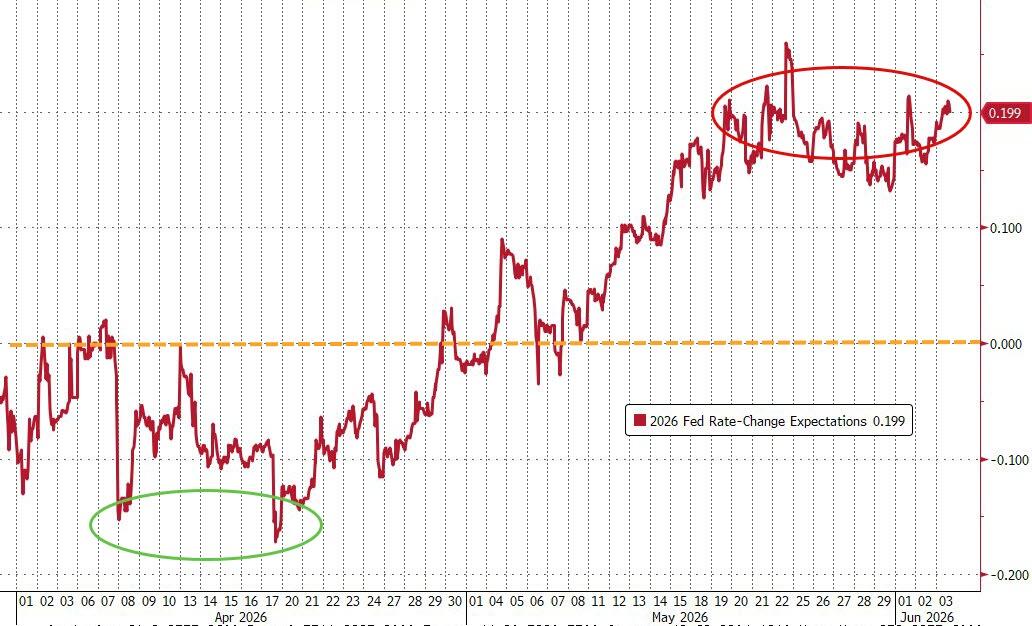
At the start of the year, we still expected that the new Chair could convince the FOMC of making three rate cuts before the year had ended.
After the outbreak of the war with Iran, we dropped one rate cut from our forecast.
However, the Strait of Hormuz is still disrupted today and gasoline prices and inflation have continued to rise.
Therefore, we repeatedly flagged that because of the developments in the Middle East, we were more likely to drop a rate cut from our forecast for 2026 than add one. Meanwhile, nonfarm payroll growth has been solid and the unemployment rate has remained at 4.3%.
As a result, the center of the FOMC has moved away from rate cuts.
What’s more, in recent weeks several Committee participants staked out their position.
Governor Waller’s conversion was the most notable. Last summer, he positioned himself as a Trump-loyalist, leading the charge to cut rates, because of increased downside risks to the labor market. After losing out to Warsh in the race for Fed Chair, he is shapeshifting again. Coincidentally, Waller jumped ship on the same day that Warsh was sworn in, making Warsh’s mission even more difficult than it already was.
Moreover, by staying on as Governor, Powell is effectively blocking the addition of another Trump-loyal Governor.
To the new Fed Chair it may feel as if he has been dropped behind enemy lines.
More inflation and less room to cut
Not completely unrelated, the situation in the Strait of Hormuz has dragged on.
RaboResearch has changed its view of the conflict and its resolution and now thinks that the Strait will be closed until September.
This has led to an upward adjustment of our energy price forecasts, which also means that we will adjust our forecasts for US inflation. More details will be provided in our Monthly Outlook next week. With our outlook for inflation higher and more persistent and the FOMC taking defensive positions against the new Chair, we now change our Fed view as well.
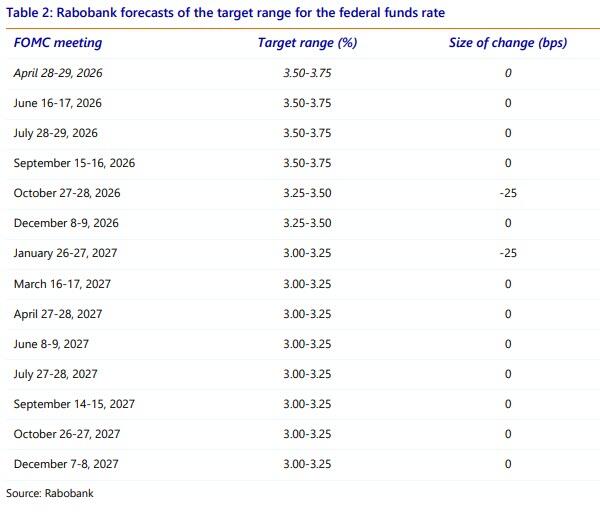
Instead of a rate cut in September 2026 and another in December 2026, we now forecast the first cut in October 2026 and the second in January 2027.
So we shift our expected rate cuts one meeting into the future. This means that we now forecast only one rate cut in 2026, instead of two.
At the same time, we add a rate cut to 2027 (previously none). The reason why we still expect the Fed to cut before the end of the year is that the conclusion by many Fed speakers that the labor market has stabilized may be a bit premature. After all, we have only just seen the first back-to-back positive nonfarm payroll growth figures in almost a year. What’s more, the fallout from the war with Iran could have negative repercussions on the real economy, even in the US. It is still a long way to the end of the year and we could easily see a return of downside risk to the labor market before we are there. In this case, the FOMC may reintroduce its easing bias.
For example, in his May 22 speech, Governor Waller said: “With regard to future rate cuts, I am going to need to see improvement on inflation or a significant deterioration in the labor market before I would consider reducing the policy rate.”
Note that he uses “or” instead of “and”, which implies that even without improvement on inflation, the labor market could be a reason to cut.
The Fed may be talking tough now, but they have a history of getting wobbly knees when the economy starts to falter. The reason why we do not shift the previous September cut beyond October, is the midterm election.
If downside risks to the labor market rise in Q3, Warsh will have a strong incentive to push for a rate cut prior to Election Day.
Therefore, the October meeting is his last chance to help boost the chances of the Republican candidates for the Senate and the House of Representatives by cutting rates and giving the stock market a lift.
Conclusion
Instead of delivering the rate cut that President Trump would have preferred, Warsh will likely have to remove the easing bias from the Fed statement at his first FOMC meeting as chair.
A sensible approach for Warsh would be to refrain from pushing for rate cuts in June and July, but instead introduce the analytical framework that will allow the FOMC to resume its prewar path of rate cutting later in the year.
If the current surge in inflation is purely a supply shock, the Fed should be able to look through the high headline inflation figures and focus on core inflation and inflation expectations.
If core inflation picks up substantially and inflation expectations become unanchored, then inflation pressures could become persistent.
However, if we see only a modest rise in core inflation and long-run inflation expectations remain stable, the Fed could resume its pre-war interest rate path, which was sloping downward.
Our forecast is now that the Fed will cut in October 2026 and January 2027, instead of September 2026 and December 2026.
So we move the rate cuts one meeting into the future.
This will still get the federal funds rate to what the median FOMC participant sees as the neutral level, only a little later.
The direction of Warsh’s mission is clear, but he may get there later than the administration might like.
How this story developed
Full timelineAlto has tracked this across 6 days of coverage from 1 outlet.
Powered by Gab AI
The Story At A Glance
Reading this article now — analysis appears below
💡 AI analysis provides alternative perspectives on current events