US Sellers Pull Homes Off Market At Near-Record Pace As Buyers Balk At High Prices
The short version
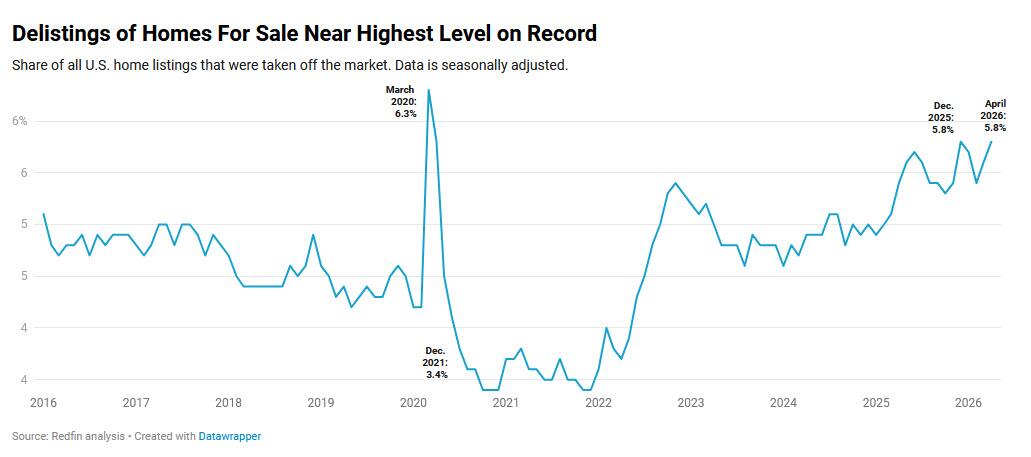
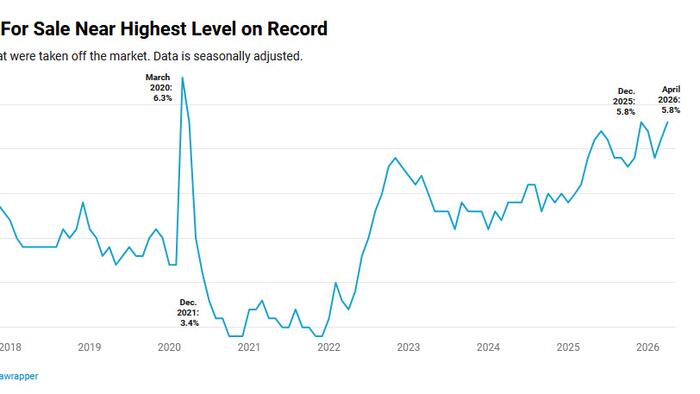
- A near record 5.8% of all US home listings were pulled off the market in April, according to Redfin .
- That’s tied with December 2025 for the highest share since March 2020, when the onset of the pandemic ground the housing market to a halt and spooked sellers.
- April delistings surged 3.8% month-over-month, the second straight month in which they have increased.
- Prior to 2020, delistings were never as common as they are now.
- Delistings are on the rise largely because it’s a buyer’s market.
The story
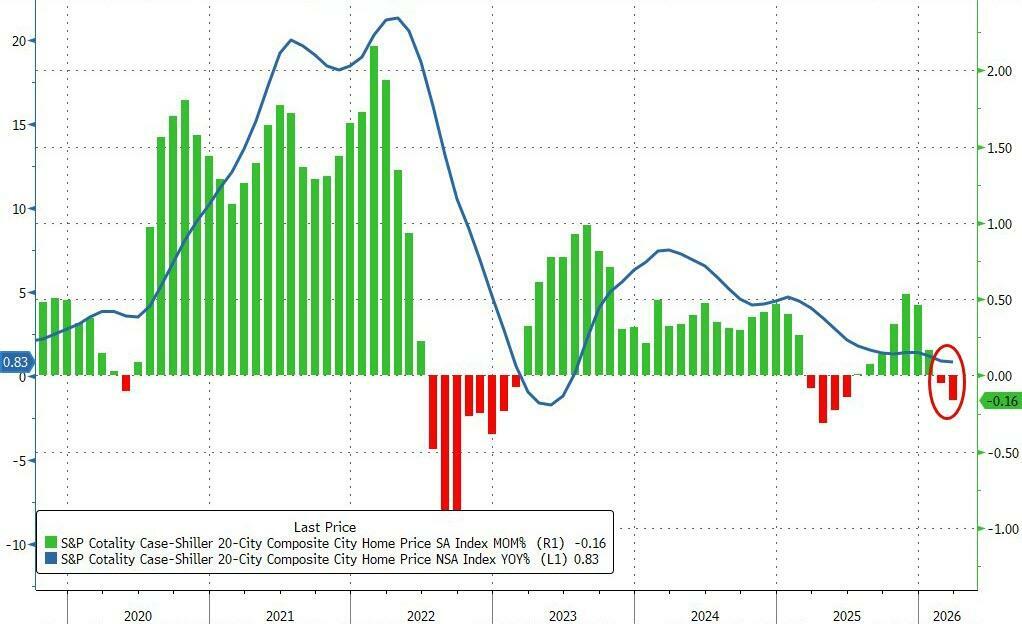
With March home prices across the US sliding sequentially almost 0.2%, and rising just 0.83% YoY, the weakest annual appreciation since July 2023...
... the balance in the real estate market is rapidly shifting away from a sellers' market. And sellers are not happy.
A near record 5.8% of all US home listings were pulled off the market in April, according to Redfin. That’s tied with December 2025 for the highest share since March 2020, when the onset of the pandemic ground the housing market to a halt and spooked sellers. April delistings surged 3.8% month-over-month, the second straight month in which they have increased. Prior to 2020, delistings were never as common as they are now.
Delistings are on the rise largely because it’s a buyer’s market. Many homeowners want to sell - but only if they can get the price they want. In many cases, prospective sellers test the waters but pull their home off the market when they don’t get the price or terms that make selling worth it. And with most homeowners in possession of sufficient liquidity buffers to avoid the need for liquidation, expect many more delistings as expectations for rapidly rising home prices crash and burn.
“Sellers are still getting used to the post-pandemic normal,” said Patricia Ammann, a Redfin Premier agent in Arlington, VA. “Prices aren’t soaring like they were five years ago–high gas prices and the rising cost of living overall is trickling down to the housing market, making buyers much less likely to bid prices up. Buyers know they have negotiating power, often offering under the asking price and completing inspections, but some sellers just won’t budge.”
The growing flood of AirBnB properties being dumped into a bidless market aside, Ammann noted that the most desirable properties still elicit multiple offers and sell above asking price with no contingencies.
According to Redfin, there are a few forces driving the trend:
- Homes are taking longer to sell. Mortgage rates came down from their recent peak in April, but they were still double pandemic-era lows–and home prices are still rising. Affordability is strained, which has pushed many house hunters to the sidelines. With fewer buyers competing for homes, sellers are more likely to wait weeks or months without a strong offer.
- Inventory is rising faster than demand. In many parts of the country, listings have piled up as more homeowners try to sell as buyer activity slows. That increased competition among sellers means some homes sit unsold, prompting owners to pull them off the market rather than cut their price.
- Some sellers still have pandemic-era price expectations. Homeowners who watched prices soar during 2020-2022 may still expect bidding wars or top-dollar offers. But today’s buyers are more price-sensitive because monthly housing costs are much higher. When sellers don’t receive the offers they anticipated, some choose to delist and wait for conditions to improve.
- Economic uncertainty is making both buyers and sellers cautious. Concerns about the Iran war, inflation, tariffs and job security are causing some homeowners to hesitate about moving unless they can get a strong price.
- Delisting can be a strategic reset. Sellers sometimes remove a stale listing to relaunch it later with a new price, new photos or during a more active season. Others are deciding to rent their homes instead, especially if they have a low mortgage rate they don’t want to give up.
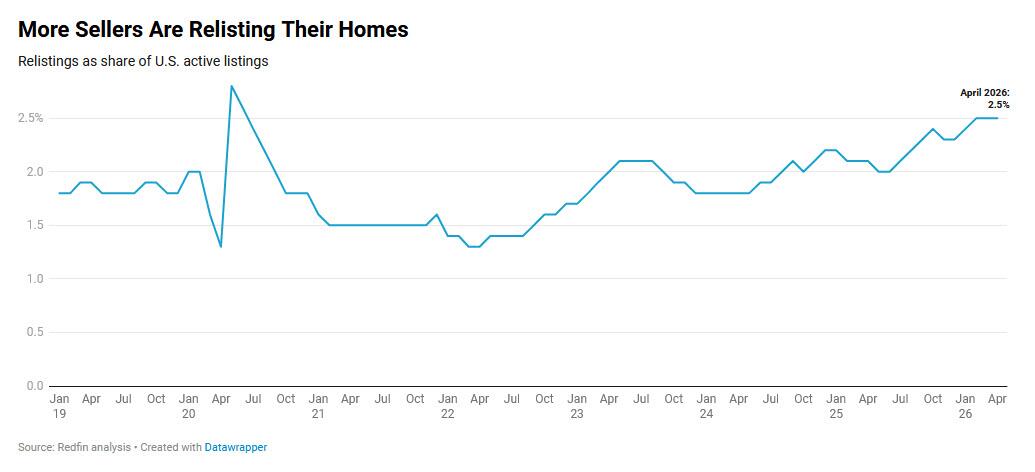
Meanwhile, as the first wave of sellers is delisting, another wave of more motivated sellers - those who delisted their homes previously - are now re-listing them: 2.5% of homes that were on the market in April belonged to sellers who had pulled their listing in the previous 12 months, then relisted. That’s tied with the prior two months for the highest share since mid-2020, when many homeowners were putting their homes back on the market after delisting at the start of the pandemic
Homeowners who pulled their home off the market over the last year are increasingly trying again as they come to terms with today’s buyer’s market. As high mortgage rates and growing inventory continue giving buyers negotiating power, sellers are aligning with the realities of the market.
They were also betting on a stronger spring market, hoping for a bump in homebuying demand after a slow few years that were marked by sky-high mortgage rates. The market did improve in April as rates dipped a bit, though it slowed down again in May as rates jumped.
“Many of last year’s sellers delisted when they couldn’t get the price they wanted. Now, some of them are circling back, willing to price realistically and do what it takes to sell their home,” said Monica DiSchiano, a Redfin Premier agent in Austin, TX. “They’ve realized that if they’re selling for less, the next home they buy will cost less, too.”
Delistings Most Common in Atlanta and San Jose
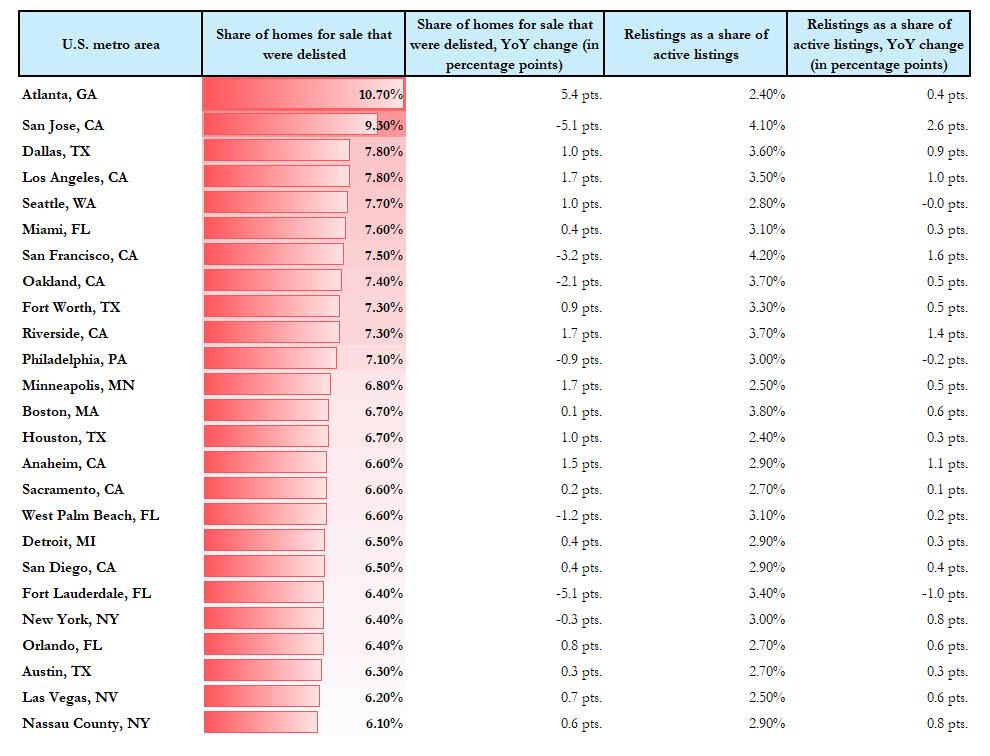
In Atlanta, one in 10 (10.7%) homes listed in April were pulled off the market–the highest share among the 50 most populous U.S. metros. Next come San Jose, CA (9.3%), Los Angeles (7.8%), Dallas (7.8%) and Seattle (7.7%). Buyers hold the negotiating power in all those metros, meaning they often try to negotiate prices down or get concessions, which can lead sellers to pull their homes off the market instead of hitting lowball bids.
Delistings were least common in Pittsburgh, where 3.5% of April’s listings were pulled off the market. Next came Columbus, OH (3.6%), Chicago (3.6%), Cincinnati (3.7%) and New Brunswick, NJ (4.4%). Chicago and New Brunswick are two of just a few metros in the U.S. that are not buyer’s markets.
Bay Area Homeowners Are Relisting at High Rate
In San Francisco, 4.2% of the homes that were on the market in April were relistings of homes that had been delisted in the prior 12 months. That’s the highest share of the metros analyzed by Redfin. It’s followed by neighboring San Jose, where 4.1% of all listings were relistings. Next came Boston (3.8%), Oakland, CA (3.7%) and Riverside, CA (3.7%).
Relistings are most prevalent in the Bay Area because the local market is hot, fueled largely by the AI boom. Many homeowners are taking advantage of rising demand by putting their houses back on the market. Relistings were least common in Pittsburgh (1.6%), also the metro area where delistings were least common. It’s followed by Virginia Beach, VA (1.7%), Cincinnati (2%), Montgomery County, PA (2%) and New Brunswick, NJ (2.1%).
The list of the 20 US metro areas with the highest delisting rates is shown below.
Source: Redfin
Related Markets
All MarketsMarket data may be delayed. Not financial advice.
How other outlets covered this
Compare allAlto found this story at 2 outlets. Same event, different framing — compare the headlines.
How this story developed
Full timelineAlto has tracked this across 22 days of coverage from 2 outlets.
Powered by Gab AI
The Story At A Glance
Reading this article now — analysis appears below
💡 AI analysis provides alternative perspectives on current events