Telegram Founder Warns UK Social Media Ban Is Digital Iceberg About To Sink The Free Internet
The short version
- His remarks arrive precisely as Keir Starmer's government rams through a social media ban for under-16s that functions as the perfect pretext for mandatory digital ID…
- The policy is dressed in the familiar language of child protection.
- In practice it requires every major platform to verify ages with facial scans, passports or credit card data.
- What starts as a restriction on minors rapidly becomes a national system of internet passports.
- Encrypted messaging apps currently sit outside the ban, but the same Online Safety Act framework already contains the levers to demand backdoors later.
The story
Authored by Steve Watson via Modernity,
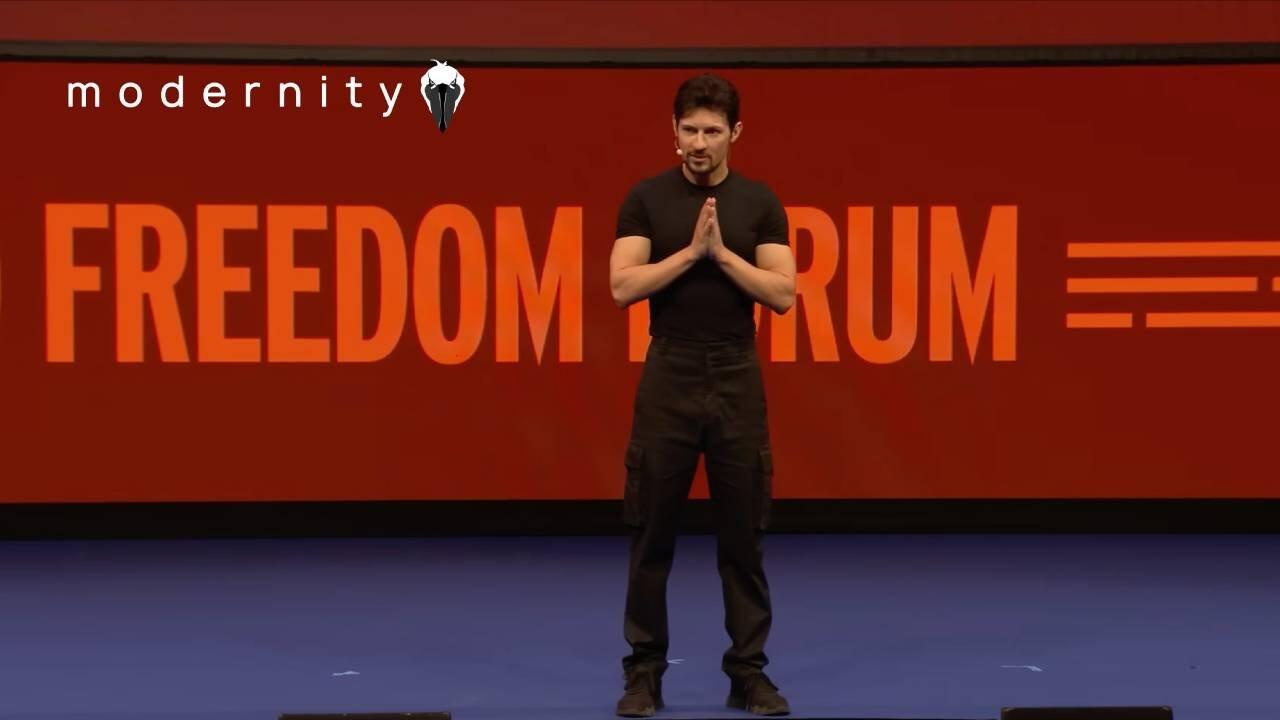
Telegram founder Pavel Durov told the Freedom Forum audience in Oslo that Western societies have already struck the iceberg and started sinking - yet most citizens remain in their cabins, convinced the ship of personal freedoms is unsinkable.
His remarks arrive precisely as Keir Starmer's government rams through a social media ban for under-16s that functions as the perfect pretext for mandatory digital ID, device-level scanning on every phone, and the practical elimination of anonymous speech online.
The policy is dressed in the familiar language of child protection. In practice it requires every major platform to verify ages with facial scans, passports or credit card data. What starts as a restriction on minors rapidly becomes a national system of internet passports.
Encrypted messaging apps currently sit outside the ban, but the same Online Safety Act framework already contains the levers to demand backdoors later. Tech executives who refuse to turn every smartphone into a government scanner face up to five years in prison.
Durov drew on two decades running major platforms and direct experience with state pressure in Russia, the EU and France. The core message was unmistakable.
"Our ship has already hit the iceberg. We have already started to sink without even realizing it. And I'm talking about the ship of our personal freedoms."
He continued, "Passengers of the Titanic actually didn't want to leave the ship for almost two hours after it hit the iceberg. People thought the Titanic was unsinkable. Lifeboats left half empty."
"Only in the last half an hour people started to panic, but by that time it was already too late. Not enough lifeboats, nowhere to hide, nowhere to run," Durov stressed.
He then turned to concrete examples. In the United Kingdom, thousands of people are arrested each year over social media posts. In Germany, posting something politically incorrect can mean fines or prison time. Durov described how "child protection" rhetoric short-circuits debate.
"Once somebody says child protection, all of a sudden it triggers very ancient, very deep parts of our brain. Who would be against protecting children? It completely bypasses logic. It bypasses debate. It bypasses rationality," he explained.
"All of a sudden, people are ready to give up everything. And authoritarian regimes were able to smuggle all kinds of repressive legislation under the guise of protecting children," he added.
He recounted Russia's failed attempt to ban Telegram. Authorities blocked the app, yet 95 percent of Russian teenagers still used it every month - many via VPNs that exposed them to far more fringe and illegal content than the original platform ever hosted.
The pattern repeats wherever governments claim they must control speech to save the children.
Starmer announced the under-16 social media ban as a way to "give children their childhoods back." The accompanying rules demand age verification across Snapchat, TikTok, YouTube, Instagram, Facebook, X and more.
Additional restrictions hit livestreaming, stranger messaging in games, and impose curfews and scroll limits for under-18s. Regulations are meant to be in force before Christmas 2026, with full enforcement by April 2027.
The machinery does not stop at apps. A parallel device-level system using "nudity detection" and monitoring is already scheduled for rollout by major phone makers this September.
If companies drag their feet, legislation will make client-side scanning mandatory. The phone itself becomes the gatekeeper - before any message is encrypted or sent.
Big Brother Watch put it plainly: this is population-wide ID checks for everyone who wants to use a phone, tablet or laptop. The government that has repeatedly failed to protect children from grooming gangs and ideological capture in schools now positions itself as the only body qualified to decide what counts as safe online."
"Its own evidence review found only a small correlation between social media use and wellbeing - no proven causal harm. That finding has been buried while the infrastructure races forward," the organisation added.
The coercion extends to corporate leadership. Draft rules under the Online Safety Act would impose up to five years in prison on tech executives whose companies refuse to build and deploy scanners that inspect every photo, video and message on user devices before encryption.
Client-side scanning turns personal phones into always-on surveillance endpoints. Privacy advocates note the "child safety" framing masks the broader project: making every smartphone a mandatory informant for the state.
Encrypted messaging services such as Signal remain exempt from the current social media ban. That exemption is fragile. The same Online Safety Act that created the age-verification regime already contains provisions that can later demand access to private communications. Signal has not stayed silent.
The company's leadership has made clear it will not implement dystopian combinations of age verification and content scanning that "will not safeguard children" and "endanger us all."
Recent statements indicate Signal is prepared to stop providing services in the UK rather than compromise the encryption its users rely on.
?BREAKING: The President of the messaging app Signal has threatened to STOP all services in the UK due to government regulations and overreach ?? pic.twitter.com/HSRNlsXAiv
- Tironianae ?? Z. - Ultra Verbum Vincet (@Tironianae) June 16, 2026
BRILLIANT!
- Jane Rochford Boleyn ?? (@VictoriaHa50399) June 13, 2026
The Signal App tell the Starmer Gov't where to go!
& EXPOSES their surveillance agenda in one go! pic.twitter.com/tiZSq0XxQZ
The warnings expose the surveillance agenda hiding behind child-protection language. Once the verification and scanning infrastructure exists, expanding it to messaging apps becomes a regulatory tweak rather than fresh legislation.
YouTube warned that blanket bans simply push young people toward anonymous, less safe corners of the internet and away from curated educational content. Meta argued against forcing users to hand over ID to dozens of separate services and floated the idea of device-level or app-store age checks instead.
These responses reveal both resistance to fragmented compliance and the companies' own interest in centralised systems they can control.
The underlying trend remains the same: the open, pseudonymous internet is being replaced by a permissioned version that requires state-approved identity.
Starmer has been branded authoritarian for good reason. The ban arrives alongside documented overreach: more than 80,000 arrests for social media posts in recent years, selective enforcement that appears to spare ideologically aligned platforms, and a broader project of tying smartphone access to digital ID.
There is a high chance Starmer will be out of office by year's end, replaced by his own party - yet the machinery he is building will outlast him.
Keir Starmer has been branded 'authoritarian' amid his crackdown on social media in the UK.
- Oli London (@OliLondonTV) June 15, 2026
Starmer is banning under 16's from social media but concerns are growing the law may be used to push for digital ID cards.
He has a 78% chance of being out as PM by the end of the year. pic.twitter.com/fo1JJv7EBe
The UK version accelerates a global pattern already visible in Canada, Australia and the EU. Each jurisdiction uses slightly different pretexts while constructing the same core capability: verified digital identity standing between citizens and the open internet.
Once every post, search, message and transaction requires state-linked identity, dissent that was previously difficult to police at scale becomes routine administrative action. An entire generation will grow up treating constant surveillance as normal.
History shows these systems are never limited to their initial stated purpose. The technology now being embedded will serve whatever purpose future governments assign it.
Durov's warning from Oslo remains the clearest summary. The ship has already hit the iceberg. The only question is how many passengers will still be below decks when the water reaches their cabins.
Related Markets
All MarketsMarket data may be delayed. Not financial advice.
How other outlets covered this
Compare allAlto found this story at 3 outlets. Same event, different framing — compare the headlines.
- VentureBeatNanoClaw comes to Slack, letting you create persistent AI agent teams and colleagues from a single message7 days ago
- The Guardian — WorldRussia accuses Telegram founder of aiding terrorism in its latest online crackdown29 days ago
- ZeroHedgeUK Government's Shocking Bid To Rig YouTube Algorithm To Force-Feed BBC Propagandaabout 2 months ago
How this story developed
Full timelineAlto has tracked this across 5 days of coverage from 3 outlets.
Powered by Gab AI
The Story At A Glance
Reading this article now — analysis appears below
💡 AI analysis provides alternative perspectives on current events