JD CEO Warns 700,000 Delivery Workers Will Be Replaced By Robots "Sooner Or Later"

The short version
- He said JD has signed deals with 120 schools to retrain couriers for roles such as robot maintenance and repair, noting that the rise of robots will require new technical jobs.
- At the same time, youth unemployment remains elevated, raising concerns that robotics and AI could squeeze both blue-collar and white-collar workers.
- The pace at which China adopts automation across its economy should outpace the U.S., given that development is happening at hyperspeed and many of the world's robotics supply…
- You were promised robots that take the night shift.
- Machines that never tire, never quit, never ask for a raise.
The story
The founder of China's largest e-commerce and logistics companies fired off a warning shot to hundreds of thousands of delivery workers that the rise of automation and AI adoption in the last-mile will result in hundreds of thousands of job losses "sooner or later."
Richard Liu, founder and chair of JD.com, told the audience at the Asia-Pacific Economic Cooperation CEO Forum in Beijing on Sunday, according to the Financial Times, that 700,000 delivery workers will be replaced by robots "sooner or later."
"In the future, when robots are delivering parcels, sooner or later, there will be a day when couriers are basically no longer needed," Liu said, adding, "It will definitely be robots delivering parcels. But I really do not want our 700,000 brothers to go without meals, without jobs."
Liu's timeline for the robotic takeover of last-mile delivery was vague and uncertain, but a number of robot delivery companies are already in pilot programs or commercialization across major Chinese cities.
He said JD has signed deals with 120 schools to retrain couriers for roles such as robot maintenance and repair, noting that the rise of robots will require new technical jobs.
Liu elaborated on the shift of some couriers into robot repair jobs, saying "robots are machinery . . . they will always, at some point, have faults."
His comments come as China's gig economy continues to expand, with temporary and blue-collar platform workers expected to reach 320 million this year, or about 40% of urban employment. At the same time, youth unemployment remains elevated, raising concerns that robotics and AI could squeeze both blue-collar and white-collar workers.
The pace at which China adopts automation across its economy should outpace the U.S., given that development is happening at hyperspeed and many of the world's robotics supply chains are based in the world's second-largest economy.
You were promised robots that take the night shift.
— Rand Group (@randgroup) June 22, 2026
The pitch writes itself. Machines that never tire, never quit, never ask for a raise. The end of human labor as we know it.
Here's what the money actually bought.
Figure is worth $39 billion. It has 40 robots loading parts at… pic.twitter.com/eeLXjHKp82
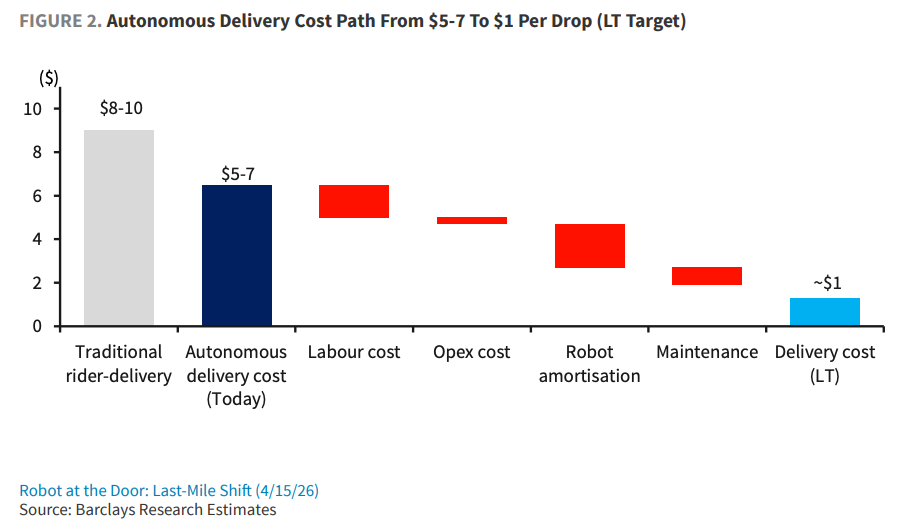
Earlier this month, Barclays internet equity analyst Ross Sandler published a note titled "Autonomous Food Delivery Likely Hits Critical Mass By 2030," outlining how automation in last-mile delivery could push delivery costs down to as little as $1 per order in the US.
"The promise of autonomous food delivery is still a few years out, but showing very positive signals in markets that have been quick to embrace it. AVs should reduce the cost of delivery for both marketplaces (currently $8-$10 per order) and for consumers (tipping, $5 per order) down to as low as $1 per order," Sandler wrote in the note.
He continued, "As witnessed already in select APAC geos with low delivery costs, when this kind of improvement happens to the cost curve, consumer adoption should go through the roof. China's online food delivery penetration is 40% of orders in tier one cities, well ahead of the US, with cost being the biggest delta."
"UBER and DASH have a number of strategies in place in both SDR (sidewalk delivery robotics) and drones, but claim that these efforts are not likely to hit a material percentage of orders until 2030 and beyond."
The analyst sees "sidewalk delivery robots as the nearer-term opportunity. Current costs are around $5 to $7 per drop, but could fall toward $1 over time as utilization improves. Drones offer faster delivery and a larger "wow" factor, but regulatory hurdles, battery limitations and airspace approvals make the path more complicated."
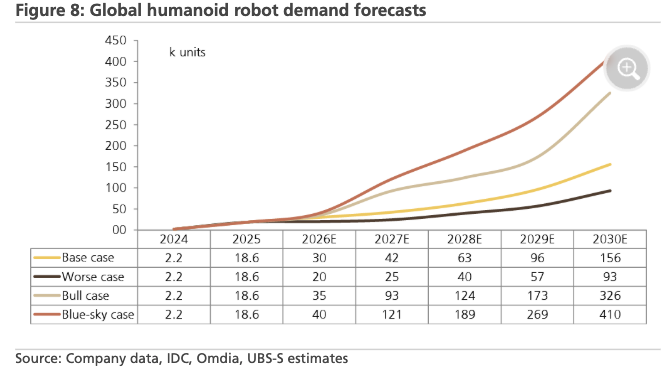
A recent UBS note on forecasts for global shipments of humanoid robots suggests the surge will begin later this year or next and really erupt in the 2030s.
There was also news earlier that Nvidia is pushing to develop software and chips to improve humanoid robot safety and enable closer human interaction, including physical collaboration in workplaces.
First signs:
The next evolution of AI is robotics, displacing blue-collar jobs in the physical world. We suspect the adoption rate will be much slower in the U.S. than in China because supply chains are not as robust in the West. But for workers in jobs that can be easily replaced by robots, such as last-mile delivery or production-line work, it may be time to find a construction job as the historic data center buildout progresses.
Blue-collar or white-collar, no one is safe from the AI revolution, as Goldman analysts revealed the top 20 college degrees most exposed to AI job disruption (read here).
We suspect that, just like data center buildouts and localized resistance, there will be public uproar when jobs are eliminated by robots later this decade.
Related Markets
All MarketsMarket data may be delayed. Not financial advice.
Powered by Gab AI
The Story At A Glance
Reading this article now — analysis appears below
💡 AI analysis provides alternative perspectives on current events