Beijing Weighs Restricting Foreign Access To China's Top AI Models
The short version
- The talks follow a number of steps by Beijing to keep homegrown AI within the country and underscore how China, like the US…
- Companies present at the talks included tech giants Alibaba and ByteDance as well as startup Z.ai , creator of the GLM-5.2 mode, said Reuters' sources.
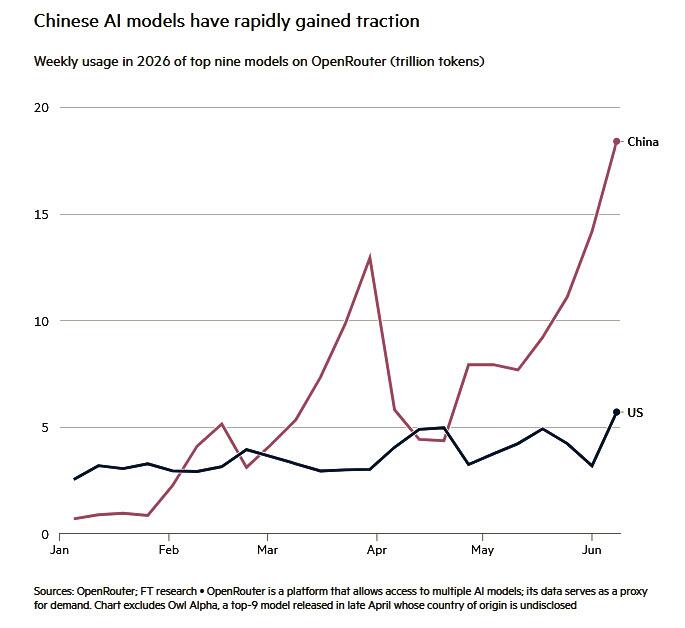
- Since the emergence of DeepSeek's R1 model last year, Chinese AI models have made massive inroads globally thanks to their low costs and increasing capabilities.
- Any decision by Beijing to limit access to those products could ripple across AI markets as costs for many businesses would likely increase.
- It would be a boon to AI supplier stocks which have plunged in recent days as a result of fears that US users of LLMs may gravitate to much cheaper, if just as capable…
The story
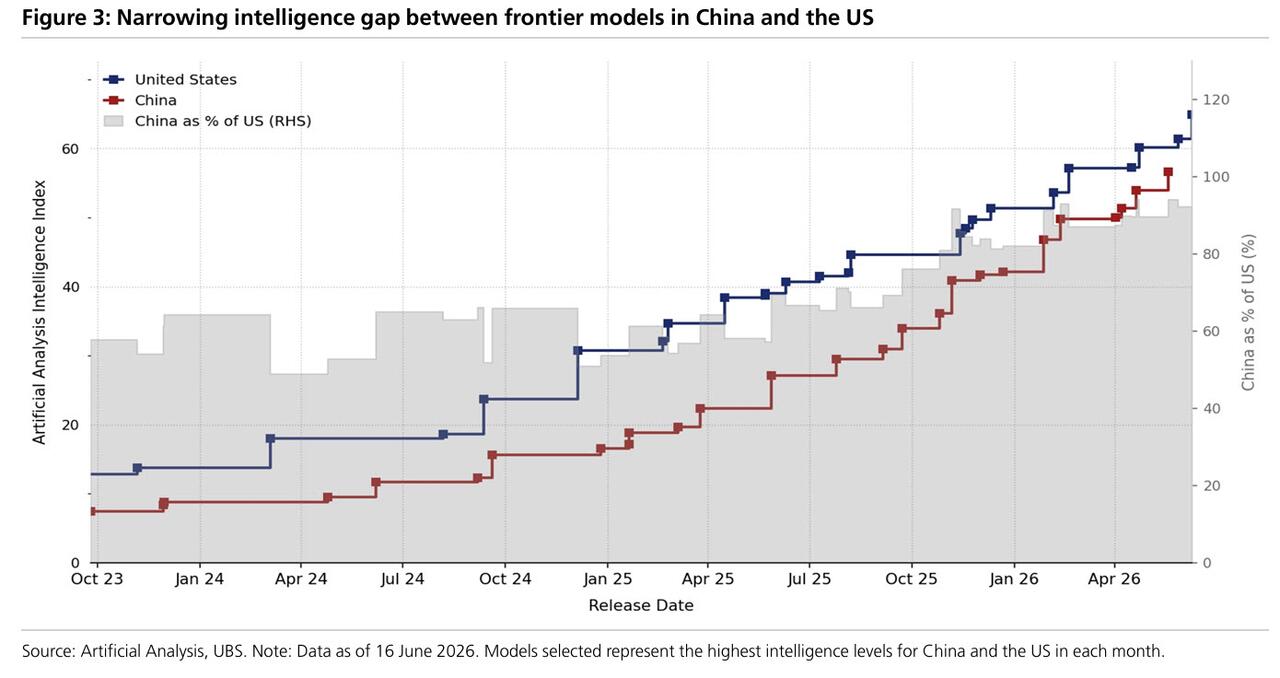
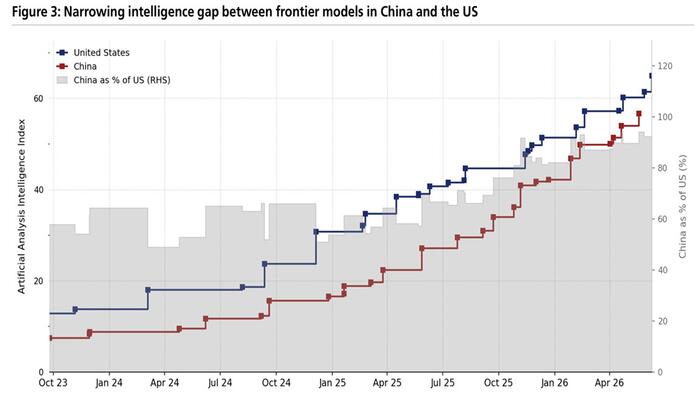
Up until now, the politicization of AI models generally ran in one direction with US "frontier" LLM providers such as Anthropic and ChatGPT complaining consistently that Chinese open-sourced models were "distilling" (i.e. reverse-engineering) their products. And whether true or not, China has certainly been able to catch up dramatically to the US, with China's latest open-model, GLM 5.2, viewed as just barely behind the latest comparable US offerings, while the average gap between US and Chinese models has shrunk to almost nothing.
As complaints on both sides have become more vocal (amid occasional bans of the latest Anthropic model by the White House admin), last week we reported that for the first time, China's tech giant Alibaba banned employees from using Anthropic's Claude Code at work after the tool drew scrutiny for features that can help identify China-linked users, Reuters reported.
Fast forward to today when the Reuters reported that in the latest escalation, Beijing is preparing to fully flip the script on the US tech sector as Chinese authorities have held meetings with top tech firms over the past month about potentially restricting overseas access to China's most advanced AI models, including those yet to be released.
The talks follow a number of steps by Beijing to keep homegrown AI within the country and underscore how China, like the US, is now treating cutting-edge artificial intelligence as a critical national asset that needs controls. Companies present at the talks included tech giants Alibaba and ByteDance as well as startup Z.ai, creator of the GLM-5.2 mode, said Reuters' sources.
Since the emergence of DeepSeek's R1 model last year, Chinese AI models have made massive inroads globally thanks to their low costs and increasing capabilities. Any decision by Beijing to limit access to those products could ripple across AI markets as costs for many businesses would likely increase. It would be a boon to AI supplier stocks which have plunged in recent days as a result of fears that US users of LLMs may gravitate to much cheaper, if just as capable, Chinese alternatives leading to huge revenue declines at US frontier companies.
At the meetings, led by China's Ministry of Commerce, participants discussed putting limits on the most advanced AI models, both closed-source and more open versions, according to two of the sources.
Officials talked about making any leak or theft of proprietary AI technology an offense under China's stringent national security law. The officials also raised the possibility of implementing new measures to restrict who can fund domestic AI startups, the source added.
The scope of the potential restrictions is still being discussed, two sources said, adding that they may only apply to future models. It was not immediately clear when or even if they would come into force.
All three leading Chinese AI companies - Alibaba, ByteDance and Z.ai - have a range of AI models, some closed-source while others are open-weight, meaning users can download, run and customise the underlying systems. Alibaba's Qwen and ByteDance's Doubao are two of the most widely used AI models in China. Z.ai has recently set Silicon Valley abuzz as the capabilities of its GLM-5.2 model come close to leading U.S. offerings but at a fraction of the cost.
Trump's administration has also been deeply concerned about national security implications of AI, in particular the potential for American AI products to be misused by military intelligence in China, Russia and other countries of concern. In June, it ordered that foreign nationals not have access to Anthropic's most advanced Fable and Mythos models, which prompted the company to disable the models for all users globally as nationality could not be verified in real time.
Export controls for Fable, which is designed for the general public, have since been lifted after new safeguards were put in place. But Mythos, designed for cybersecurity professionals, is still only available to some "trusted" U.S. organizations.
Some US AI experts have also said the US needs to regulate the use of Chinese AI models. According to two of the sources, Chinese authorities are deeply worried about the potential for Mythos to exploit software vulnerabilities and that Washington might deploy the model against Chinese interests.
That echoes concerns publicly voiced by state media and Zhou Hongyi, founder of cybersecurity firm 360, a major vendor to government and enterprise clients, who has said China needs to develop its own Mythos.
Amid the rising techno-nationalism, China has implemented numerous measures to protect homegrown AI this year. In April, the country's state planner ordered Meta to unwind its $2 billion acquisition of Chinese-founded AI startup Manus. In early June, authorities issued sweeping new rules, tightening control of overseas deals that involve Chinese investors, technology, data and national security.
China had also launched investigations this year into Manus and other local AI startups that had moved abroad, seeking to establish whether they have broken export control laws, according to two of the sources and a third person.
In its report, Reuters says that it was not able to learn how any potential new restrictions on overseas access to Chinese AI models might work. But some hints might be gleaned from a May roundtable of Chinese legal experts on regulations governing open-source AI.
According to a summary of the discussions published in an official Supreme People's Court journal, participants proposed a tiered system: basic open-source tools subject to a simple filing, more advanced technologies facing security reviews, and the most sensitive frontier models barred from public release or restricted to domestic use.
If indeed China is about to start its own AI "firewall", the question is what happens then? Recall, in blowback to the short-lived tokenmaxxing idiocy, a growing number of American enterprises are quietly gravitating toward cheaper Chinese models.
But if China itself limits access to US clients, does this mean that the balance of power shifts back to US LLMs which will then become the only available AI vendors to US corporations. If so, is Beijing making a big mistake depriving its nascent AI ecosystem of US client revenues, and instead allowing US models - which recently found themselves on the defensive in response to much cheaper Chinese alternative - to take an even bigger lead for round 2?
Related Markets
All MarketsMarket data may be delayed. Not financial advice.
Powered by Gab AI
The Story At A Glance
Reading this article now — analysis appears below
💡 AI analysis provides alternative perspectives on current events