How Global Population Growth Is Slowing
The short version
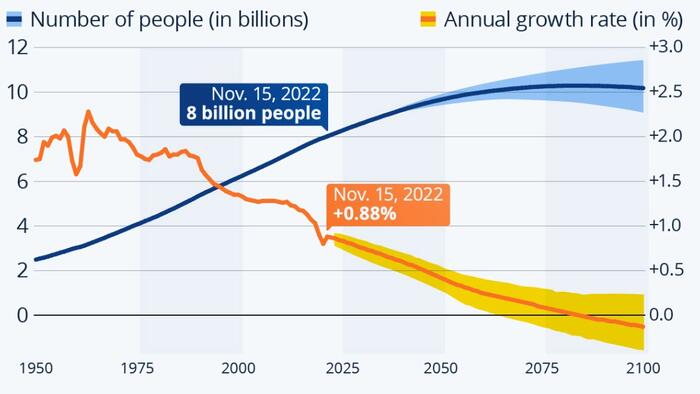
- However, as Statista's Katharina Buchholz reports , by the end of the century, this number will have started to decline slightly, having reached a high around 10.3 billion in 2084.
- Leading up to this reversal, the growth of the global populace has actually been slowing down for decades, as seen in numbers by the UN Population Division.
- The organization celebrated World Population Day on Saturday.
- This would result in a world population around 9 billion again by the end of the century.
- Some academics believe that a global population decline at an even faster rate is possible.
The story
According to UN calculations, the world's population will cross the 10-billion mark in 2061.
However, as Statista's Katharina Buchholz reports, by the end of the century, this number will have started to decline slightly, having reached a high around 10.3 billion in 2084. Leading up to this reversal, the growth of the global populace has actually been slowing down for decades, as seen in numbers by the UN Population Division. The organization celebrated World Population Day on Saturday.
You will find more infographics at Statista
While the above figures are according to the UN's medium scenario of moderate fertility, a case where global birth rates sink even more drastically would result in a reversal of population growth already around the early 2060s, at a high of just under 10 billion people on Earth.
This would result in a world population around 9 billion again by the end of the century.
Some academics believe that a global population decline at an even faster rate is possible. According to an widely cited article in medical journal The Lancet published in 2020, the world population is expected at 8.8 billion in 2100, comparable to the UN's low-fertility scenario. In case of rapid global development, the reseachers believe it could be as low as 6.3 billion by that time.
The number of people in the world exceeded 8 billion for the first time on November 15, 2022, according to UN calculations.
This was more than three times as many as in 1950. The rapid growth of the past was due to the gradual increase in life expectancy as a result of improvements in healthcare, nutrition, personal hygiene and medicine. It was also the result of high and consistent birth rates in some countries, for example China and India.
At present, the country adding most people to the world population is still India, while African countries like the Central African Republic, Chad and Somalia have the highest birth rates.
By contrast, the list of countries with the fastest population decline is dominated by eastern and southeastern European states, which have to contend with high emigration figures due to the wage and development gap with western Europe as well as falling birth rates.
How this story developed
Full timelineAlto has tracked this across 3 days of coverage from 1 outlet.
- How Global Population Growth Is SlowingYou are here
Powered by Gab AI
The Story At A Glance
Reading this article now — analysis appears below
💡 AI analysis provides alternative perspectives on current events



