Venezuela's Oil Revival Faces A Critical Services Bottleneck
The short version
- International oil companies led by Chevron are expected to deliver nearly two-thirds of the forecast production increase through brownfield investments.
- The biggest obstacles are operational, including drilling rigs, diluent supplies, infrastructure upgrades, and a competitive fiscal regime capable of attracting long-term…
- Venezuela's upstream industry has entered a new phase.
- Following sweeping hydrocarbon reforms and broader geopolitical developments in early 2026, the conversation has shifted from whether the country can reopen its oil sector to…
- The country's resource potential has never been in doubt.
The story
Authored by Rystad Energy via OilPrice.com,
-
Venezuela could increase crude production by about 194,000 bpd by late 2028, with most growth coming from existing producing fields rather than new discoveries.
-
International oil companies led by Chevron are expected to deliver nearly two-thirds of the forecast production increase through brownfield investments.
-
The biggest obstacles are operational, including drilling rigs, diluent supplies, infrastructure upgrades, and a competitive fiscal regime capable of attracting long-term investment.
Venezuela's upstream industry has entered a new phase. Following sweeping hydrocarbon reforms and broader geopolitical developments in early 2026, the conversation has shifted from whether the country can reopen its oil sector to whether it can successfully execute a meaningful production recovery. The country's resource potential has never been in doubt. The greater challenge now lies in converting policy momentum into sustained operational growth.
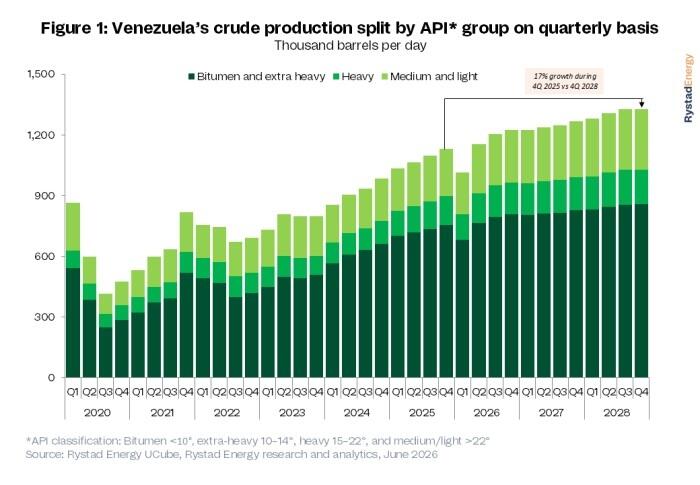
Rystad Energy estimates Venezuela's crude production could increase by approximately 17%, or around 194,000 barrels per day (bpd), between the fourth quarter of 2025 and the fourth quarter of 2028. Importantly, this growth is expected to come primarily from existing producing assets rather than large-scale new discoveries, highlighting that operational execution, not resource availability, will determine the pace of recovery.
Near-term production growth will be dominated by heavier crude grades. Around three-quarters of Venezuela's output through 2028 is expected to come from heavy, extra-heavy crude and bitumen, with the Orinoco Oil Belt accounting for roughly 60% of total production. This makes access to diluents, workover activity, infill drilling, and mature field management considerably more important than reserve additions over the next several years.
Venezuela upstream figure 1
International operators are driving the recovery
International oil companies (IOCs) are expected to contribute nearly two-thirds of Venezuela's forecast production increase through 2028. Chevron remains the largest contributor, followed by Repsol, Eni, Maha Energy and Maurel & Prom. Most of this growth is expected to come from expanding production at existing joint ventures, reflecting renewed investment following regulatory changes and sanctions relief rather than greenfield developments.
Chevron continues to occupy a particularly strategic position. Recent portfolio adjustments have strengthened its exposure to the Orinoco Oil Belt, while future production growth is expected to rely on brownfield optimization, infill drilling and the phased development of Ayacucho 8. Beyond Chevron, companies such as Eni and Repsol continue to play a dual role in both Venezuela's crude and natural gas sectors through assets including the Cardón IV block and the giant Perla gas field.
However, international participation remains highly selective. Companies continue to balance the opportunity presented by Venezuela's vast resource base against fiscal uncertainty, operational complexity and long-term investment risk.
Execution, not geology, remains the key constraint
While policy reforms have improved the investment outlook, they do not eliminate the operational bottlenecks that have constrained production for years.
Sustained production growth will require continuous access to diluents, higher drilling activity, extensive workover campaigns, improved infrastructure and significantly greater rig availability. These operational requirements represent the critical link between resource potential and realized production.
Fiscal competitiveness also remains an important consideration. International operators have indicated that future capital commitments will depend on further improvements to Venezuela's fiscal framework, particularly around royalty rates and taxation. Lower project breakeven costs through more competitive fiscal terms could materially improve investment economics and encourage broader participation across the sector.
Oilfield services could become the industry's defining bottleneck
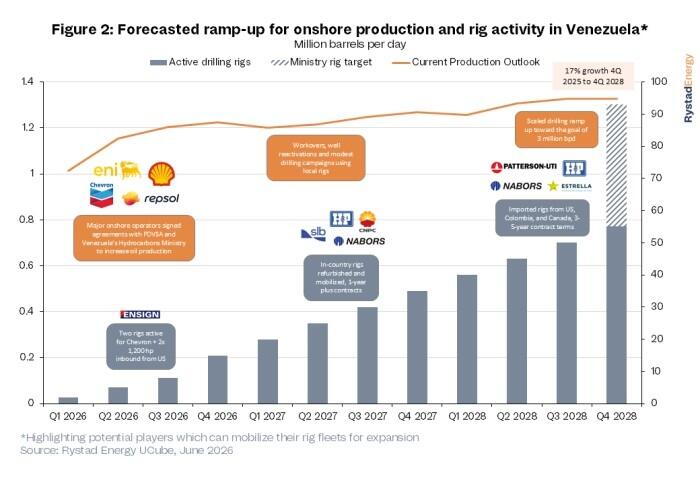
Perhaps the greatest challenge facing Venezuela's recovery lies beyond the upstream operators themselves. The Venezuelan Oil Ministry has identified a requirement for 93 active drilling rigs by 2028, a significant increase from current activity levels. Achieving this target would require a phased expansion involving reactivating domestic rigs, refurbishing idle equipment, and eventually importing additional rigs from international markets.
This creates substantial opportunities for drilling contractors and oilfield service providers but also highlights the scale of the execution challenge. Companies must balance equipment mobilization costs, contract duration requirements, and country risk before committing capital.
Local contractors have begun reactivating existing fleets, while international service providers remain more cautious, waiting for greater evidence that recent policy reforms will translate into a stable, commercially attractive operating environment. As a result, rebuilding operational capacity may ultimately prove just as important as attracting upstream investment.
Venezuela upstream figure 2
The next phase depends on implementation
The 2026 Hydrocarbons Law represents one of the most significant structural reforms to Venezuela's upstream sector in decades. By expanding opportunities for private participation and introducing greater fiscal flexibility, the legislation has created a more attractive framework for future investment.
Yet legislation alone cannot restore production. The speed of implementation, the stability of fiscal policy, continued sanctions relief, and the industry's ability to rebuild operational capacity will ultimately determine whether Venezuela can translate ambition into sustained output growth.
For investors and operators alike, the opportunity is considerable. But the country's upstream revival will depend less on the size of its resource base than on its ability to consistently execute across drilling, infrastructure, services, and investment policy. That execution gap, not geology, is likely to define Venezuela's production trajectory over the remainder of the decade.
Related Markets
All MarketsMarket data may be delayed. Not financial advice.
How this story developed
Full timelineAlto has tracked this across 2 days of coverage from 1 outlet.
- Venezuela's Oil Revival Faces A Critical Services BottleneckYou are here
Powered by Gab AI
The Story At A Glance
Reading this article now — analysis appears below
💡 AI analysis provides alternative perspectives on current events