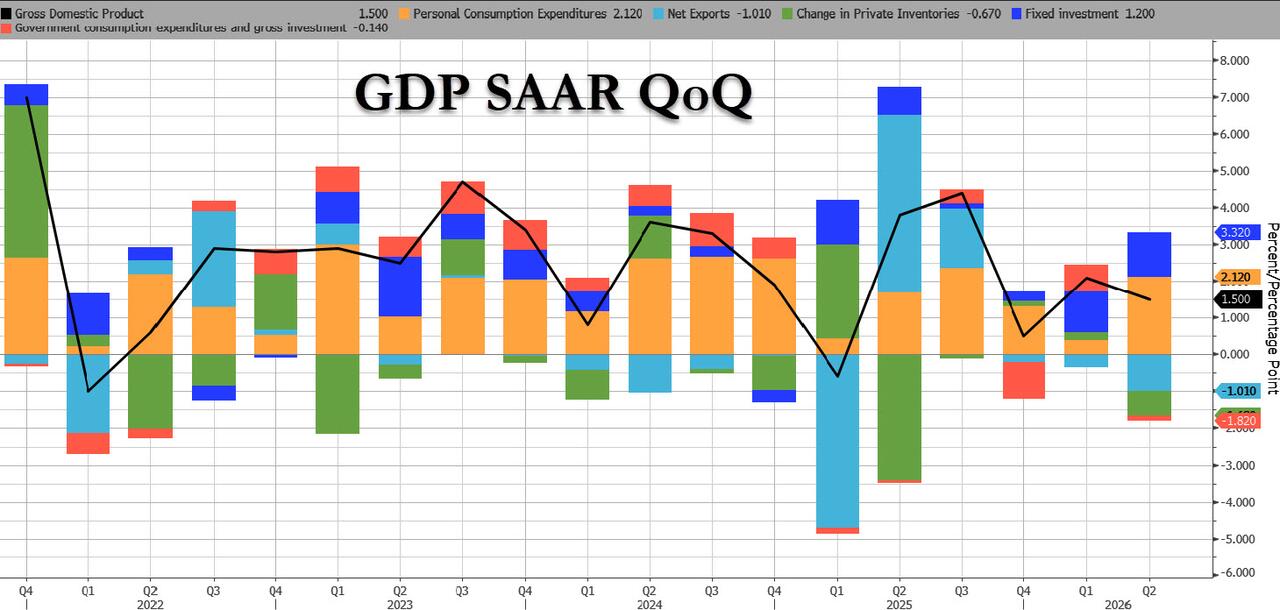
US Grows Only 1.5% In Q2, Badly Missing Estimates, Despite Strong Spending, Investment
The short version
- According to the BEA, GDP (inflation adjusted) rose just 1.5% in the period, according to the first estimate issued Thursday by the Bureau of Economic Analysis.
- This was well below the 2.0% median estimate.
- The contributors to the increase in real GDP in the second quarter were increases in consumer spending, investment…
- A decline in volatile net exports masked strength in underlying demand as i mports, which are a subtraction in the calculation of GDP, increased.
- Consumer spending, which comprises about two-thirds of economic activity, rose at a 3.2% rate.
The story
The US economy grew at a far weaker than expected pace in the second quarter despite a pickup in consumer spending and solid business investment. According to the BEA, GDP (inflation adjusted) rose just 1.5% in the period, according to the first estimate issued Thursday by the Bureau of Economic Analysis. This was well below the 2.0% median estimate.
The contributors to the increase in real GDP in the second quarter were increases in consumer spending, investment, and exports that were partly offset by a decrease in government spending. A decline in volatile net exports masked strength in underlying demand as imports, which are a subtraction in the calculation of GDP, increased. Consumer spending, which comprises about two-thirds of economic activity, rose at a 3.2% rate. Business investment continued to boom amid a debt-fueled rush to invest in artificial intelligence.
A closer look at the underlying data:
- Business investment remained a key driver of growth in the second quarter. The massive AI investment push continued to play a critical role as did demand for industrial and transportation equipment. After the Fed decided to keep interest rates unchanged on Wednesday, Chairman Kevin Warsh described the economy’s resilience as “impressive” but noted its “most striking” feature is the strength of business investment.
-
The GDP report showed nonresidential fixed investment rose at an 8.4% pace. Investment in industrial equipment surged by the most since 2011, and outlays for transportation equipment jumped by the most in two years. Information processing equipment and software outlays rose at a strong, albeit slower rate.
-
- Net exports subtracted a percentage point from the calculation of GDP in the second quarter. That likely reflected a mix of factors, including efforts to get goods into the country before a new wave of tariffs and the rapid pace of capital investment.
- Inventories stripped an additional 0.67% from GDP, suggesting many businesses drew down their inventories during the war.
- Federal government outlays declined, reflecting sales of crude oil from the Strategic Petroleum Reserve, according to the report. But because sales of the oil are reflected in other components of GDP, there is “no direct effect” on GDP. Even so, spending on national defense increased amid the war with Iran.
Meanwhile, the strength in household outlays was fueled by spending on durable goods like furnishings and motor vehicles. Within services, consumers ramped up outlays on discretionary categories like recreation and food services and accommodation.
Because swings in trade can distort GDP, economists pay close attention to a narrower metric of underlying demand known as final sales to private domestic purchasers that excludes net exports, changes in inventories and government spending. This measure climbed 3.9% in the second quarter, more than double the first quarter pace and the strongest since early 2023.
As Bloomberg notes, the latest data highlight an economy that’s so far powering through the fallout of the Iran war, while getting the benefit of a historic credit-fueled spending spree behind AI spending. While the conflict has pushed prices higher and weighed on sentiment, a slide in gasoline costs at the end of the quarter alongside higher-than-usual tax refunds and sales promotions helped support household spending.
As reported earlier, more up to date data released on Thursday showed inflation-adjusted consumer spending climbed a robust 0.4% in June, matching the strongest since July 2025. The Federal Reserve’s preferred measure of inflation - the personal consumption expenditures price index - fell 0.1% last month. Excluding food and energy, the index rose less than forecast.
Looking ahead, Bloomberg notes that the recent flare-up in the Middle East and President Donald Trump’s new tariffs underscore the uncertainty around the outlook. Though the US central bank opted to keep rates unchanged on Wednesday, three policymakers voted to raise borrowing costs amid above-target inflation.
But with layoffs limited, economists generally expect consumer spending to stabilize in the second half of the year. Executives at companies like JPMorgan Chase & Co. and Levi Strauss & Co. have underscored shoppers’ resilience, even as some like PepsiCo Inc. and General Mills Inc. have noted that Americans are growing more discerning in their spending.
Related Markets
All MarketsMarket data may be delayed. Not financial advice.
How this story developed
Full timelineAlto has tracked this across 23 days of coverage from 1 outlet.
Powered by Gab AI
The Story At A Glance
Reading this article now — analysis appears below
💡 AI analysis provides alternative perspectives on current events