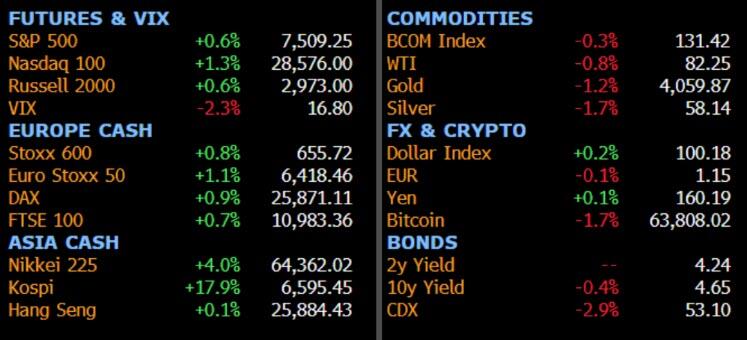
Futures Rise After Record Rip In Kospi; Bond Bounce Fades As Oil Jumps, BoJ On Hold
The short version
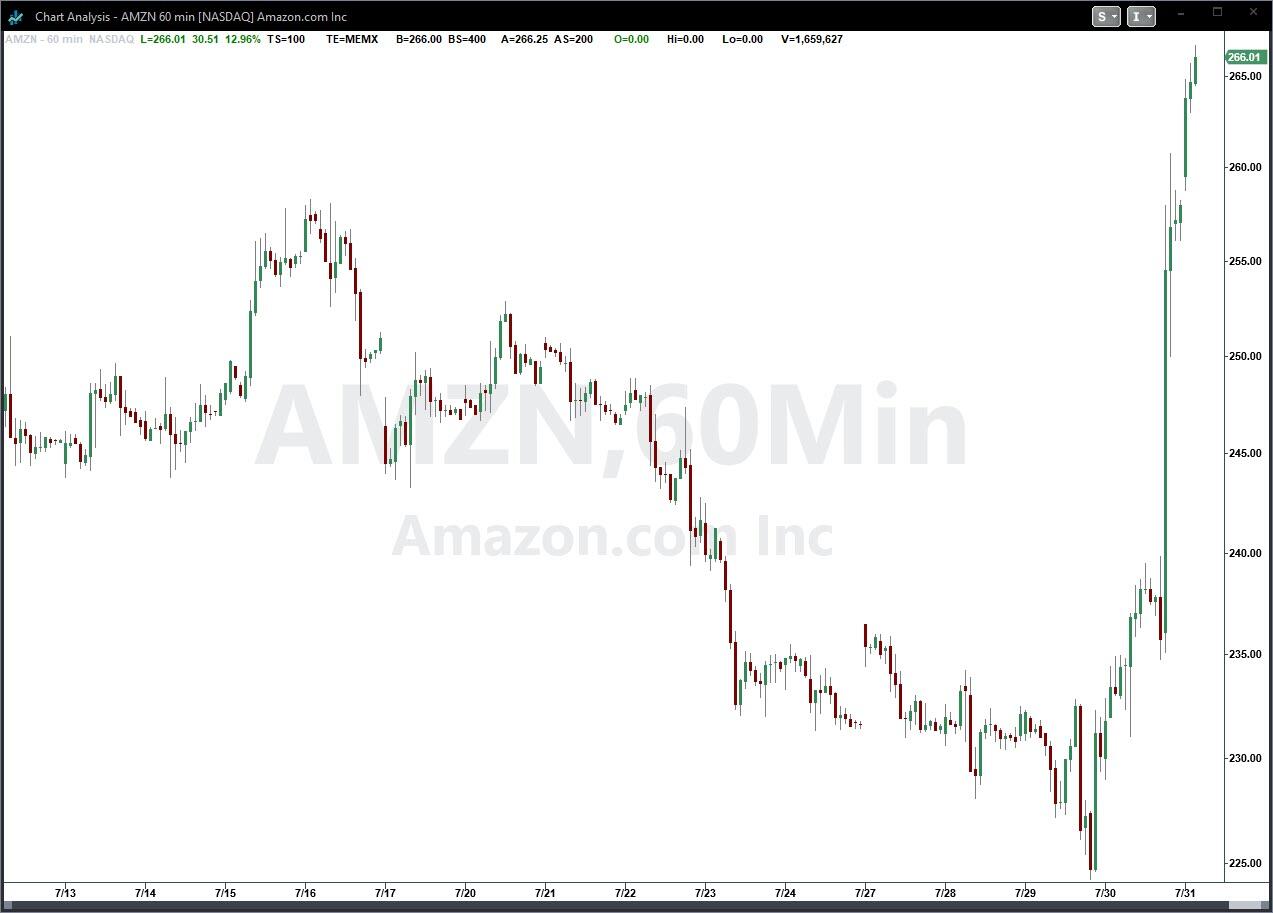
- Amazon is the standout in premarket trading, up by 12% after reporting a fifth quarter of cloud sales growth, while Apple is sinking 7% after its sales forecast was dented by…
- The gains in big-tech come amid signs that, for some, AI spending is paying off - underpinned by strong demand.
- Amazon shares rallied in late trading after it reported AWS revenue growth of 37%, above consensus of 31.3% and the fastest clip since 2021…
- On the flip side, Apple shares fell after component shortages weighed on the company’s sales forecast, echoing caution mentioned by Qualcomm the previous day.
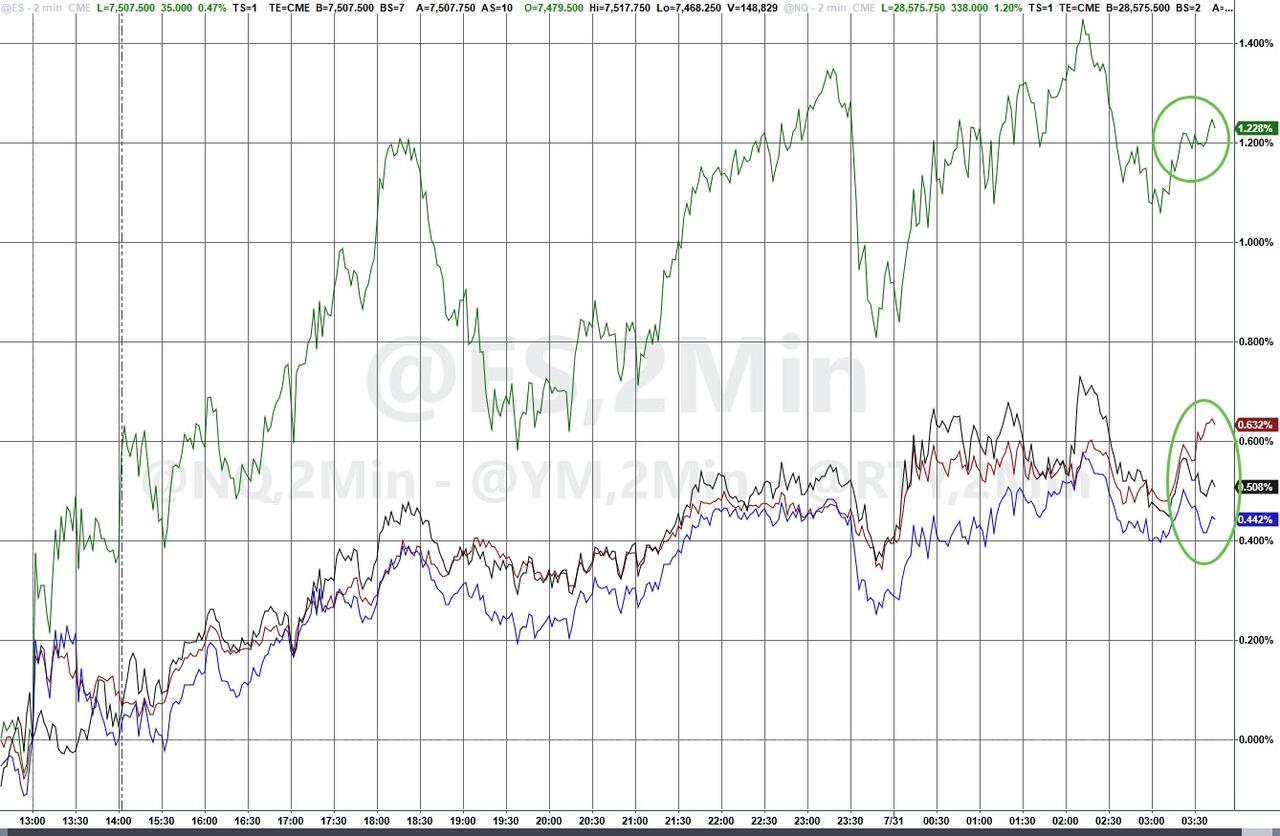
- So this is not the end of the AI trade, it is probably the end of its easy phase.” Nasdaq 100 futures climbed 1.2%, while those for the S&P 500 rose 0.5%.
The story
A broad rally in US tech stocks is extending for a second day, with Nasdaq 100 futures rising over 1%. Amazon is the standout in premarket trading, up by 12% after reporting a fifth quarter of cloud sales growth, while Apple is sinking 7% after its sales forecast was dented by industry-wide supply shortages.
The gains in big-tech come amid signs that, for some, AI spending is paying off - underpinned by strong demand. Amazon shares rallied in late trading after it reported AWS revenue growth of 37%, above consensus of 31.3% and the fastest clip since 2021, enabling traders to overlook another increased capex guide and negative free-cash flow.
On the flip side, Apple shares fell after component shortages weighed on the company’s sales forecast, echoing caution mentioned by Qualcomm the previous day. Apple had run into the print as the best performing stock within the Mag 7 cohort year-to-date.
“The worst of the positioning washout is probably behind us,” said Florian Ielpo at Lombard Odier Investment Managers. “On valuations, I would say they are more reasonable than a month ago, not cheap. So this is not the end of the AI trade, it is probably the end of its easy phase.”
Nasdaq 100 futures climbed 1.2%, while those for the S&P 500 rose 0.5%.
With earnings season past the half-way mark, 86% of the 291 S&P 500 companies reported have beaten estimates, tracking the highest pace in five years, according to Bloomberg Intelligence data.
AI-linked stocks “breathed a giant sigh of relief,” writes Vital Knowledge founder Adam Crisafulli, noting many investors attributing the pain of the last several weeks exclusively to technical dislocations. But the industry isn’t in the clear as there remains “a spending sustainability problem when it comes to AI that’s not going away as people continue to question the ultimate ROI on the mountains of capital being ploughed into data centers,” Crisafulli adds.
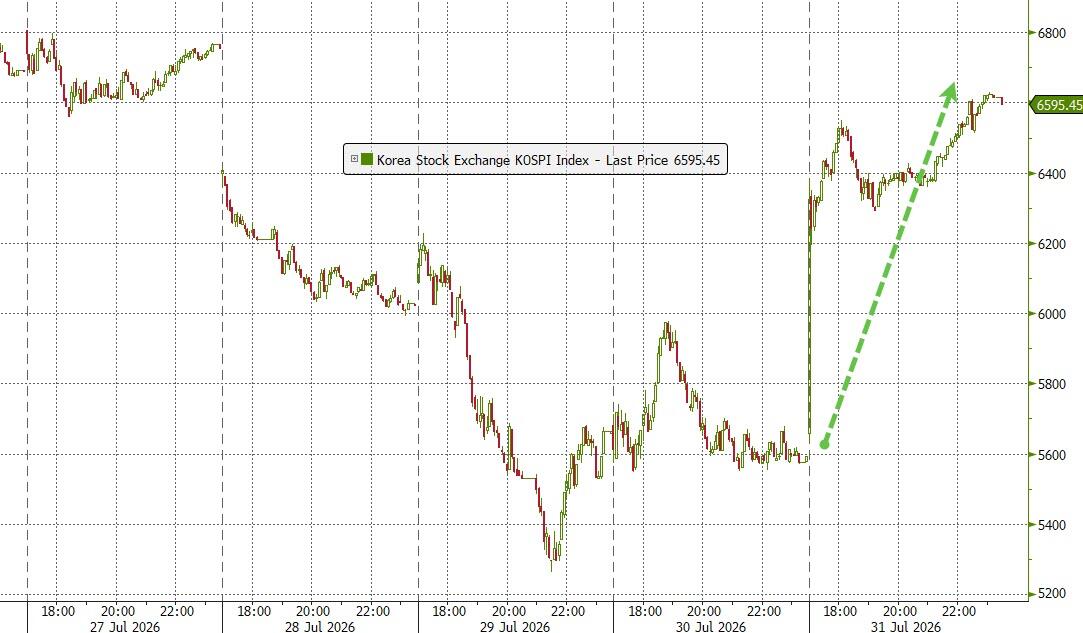
After a volatile month, the hyperbolic moves (down and up) are nowhere more exemplified than by a record rally in South Korea’s Kospi Index overnight.
An unprecedented 18% surge in South Korea’s Kospi Index led the global charge after memory giant SK Hynix Inc. hit the 30% daily limit.
Europe’s Stoxx 600 headed for a record high, with just over half of Stoxx 600 firms having topped expectations, according to Barclays.
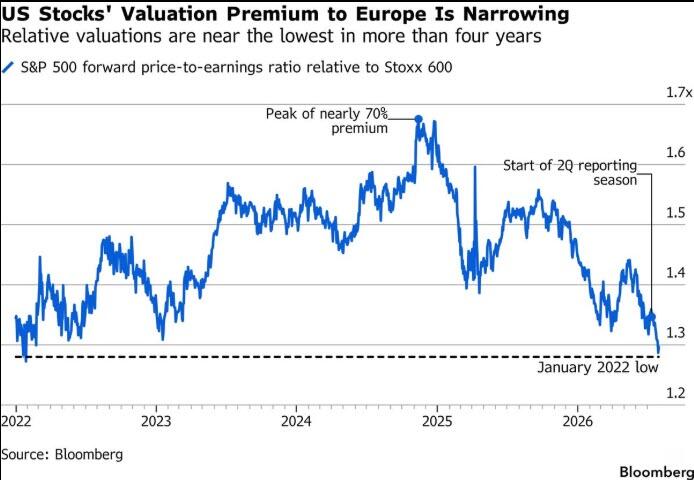
And yet, US stocks’ valuation premium to European stocks is near the lowest since January 2022. Even with futures pointing to gains Friday, the S&P 500 is on track for its first decline in July since 2014.
Elsewhere, we have more delveraging pain as a hedge fund managed by Jupiter Research Capital lost more than 40% of its value in just over three weeks of trading this month. The news comes fast on the heels of Situational Awareness selling a chunk of its AI-related public equities.
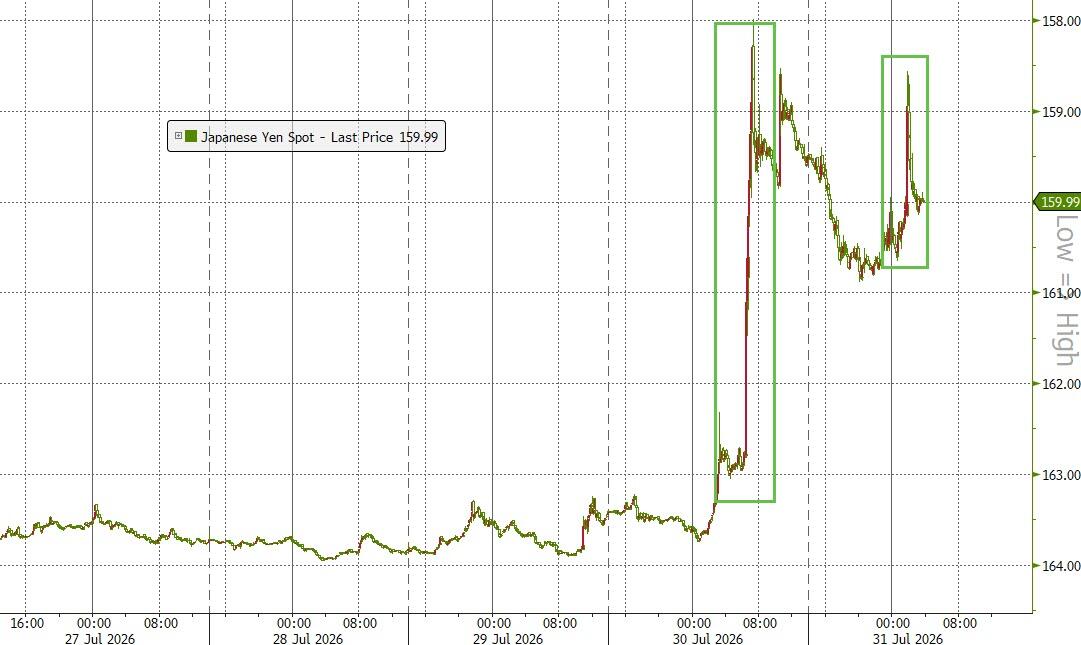
The yen briefly saw a sharp rise against the dollar a day after authorities intervened to support the currency and following the BOJ’s decision to keep rates on hold.
Strategists view Bank of Japan Governor Kazuo Ueda’s comments at press conference following the central bank’s decision to hold rates as moderately hawkish with some expecting an earlier rate hike.
The Bloomberg Dollar Spot Index fluctuated with the yen, but is now up about 0.2% again.
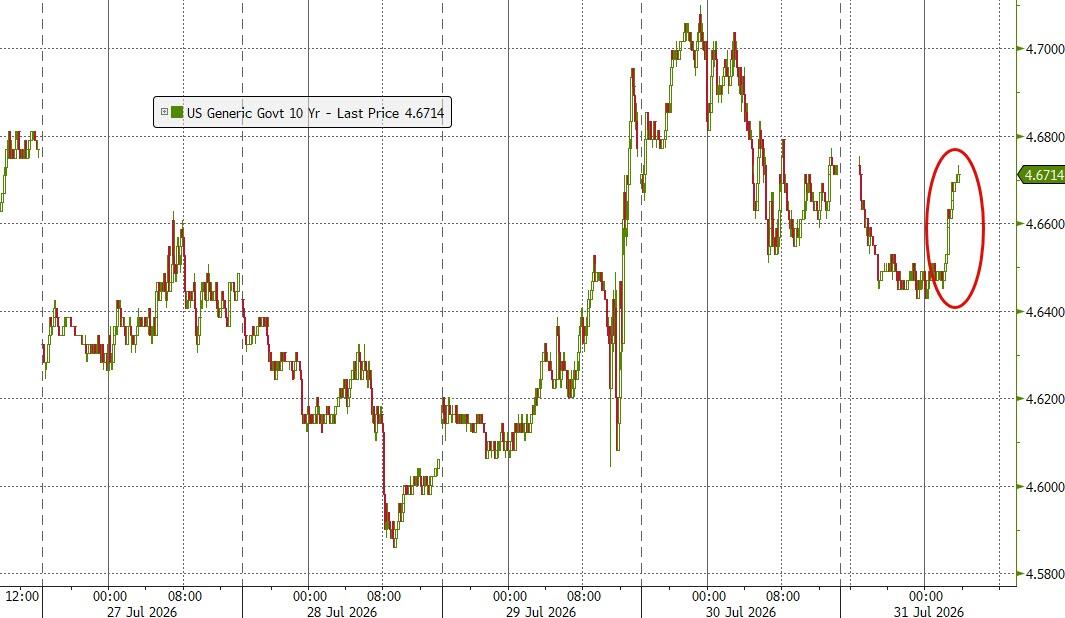
Treasuries are leading the gains in bond markets and mostly at the long end, with 30-year yields falling by around two basis points.
“While the messaging on inflation has been firm, investors are still trying to assess how that commitment will translate into policy decisions,” said Francisco Simon at Santander Asset Management. “The combination of a credible inflation objective, but less visibility on the path of policy decisions, could translate into higher volatility in rates markets.”
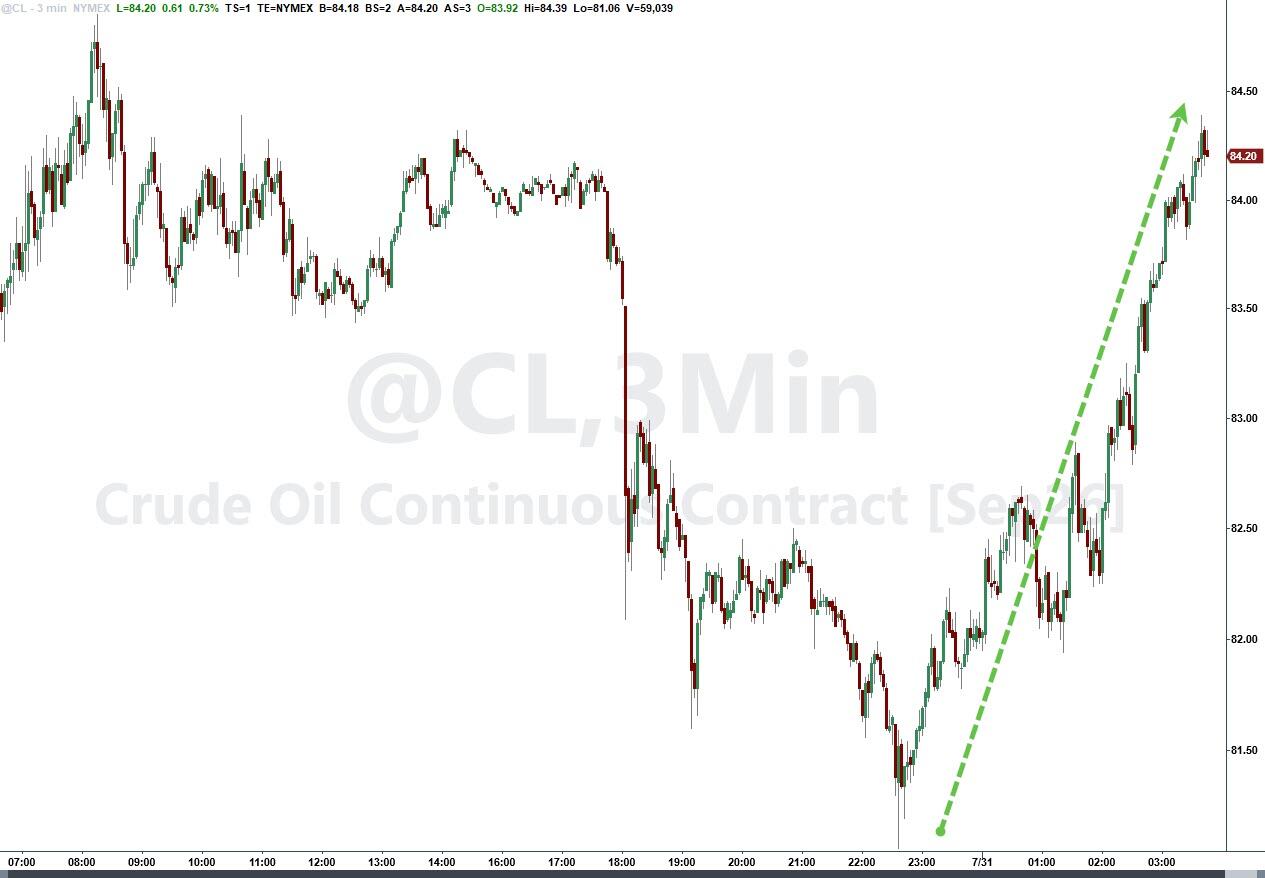
Those gains in bonds, however, paring after oil prices erased their decline for the day following headlines than Iran is blocking the passage of six tankers in the Strait of Hormuz. Brent is on track for a jump of around 20% for July and is currently trading around $89/barrel.
And gold is falling to get nearer to $4,000/oz.
Meanwhile, China’s manufacturing PMI unexpectedly slipped back into contraction as weak domestic demand continues to weigh on growth (iron ore creaking).
10 Things You Shouldn't Miss This Morning
(via Goldman's Jack McKeon)
1) Japan and South Korea have stepped in to buy their currencies, possibly with involvement from the United States, in a rare coordinated intervention, sources and analysts said. The intervention gave the yen its biggest boost in almost two years and, if the past is any guide, any joint effort with the U.S. may prove strong enough to turn around the battered currency. CNBC
2) BOJ keeps interest rates steady at 1%, as expected. on Friday they warned for the first time that underlying inflation could exceed its target and said future policy discussions would focus on upside price risks, signaling the chance of a rate hike as soon as September. The hawkish signals came after the government's suspected yen-buying market intervention in New York markets on Thursday that underscored Tokyo's concern over the pain the weak yen was inflicting on households through rising import costs. RTRS
3) China’s factory activity unexpectedly contracted in July for the first time since February, as domestic orders slumped and typhoons disrupted production, while part of the front-loading momentum began to unwind, piling pressure on Beijing to boost domestic demand. BBG
4) Eurozone CPI was inline on the headline for Jul at +2.9% (up from +2.8% in June) while core ran a bit hot at +2.5% (vs. the Street +2.4% and up from +2.4% in June). BBG
5) South Korea’s Kospi surged by a record 18% as SK Hynix hit the 30% daily limit and Samsung soared. BBG
6) Chevron beat estimates as prices for crude, gasoline and diesel surged. Exxon narrowly missed forecasts on maintenance costs. BBG
7) Donald Trump signed an order allowing export restrictions on industrial waste containing critical minerals, aiming to boost US supplies and reduce reliance on China for key materials. BBG
8) Microsoft made market history. The software giant added $450 billion, the biggest one-day gain ever by a stock, after shares closed up 16% yesterday on surging cloud revenues. That’s bigger than 96% of S&P 500 companies. BBG
9) Tesla is weighing the separation of its China unit ahead of a potential SpaceX merger, according to the WSJ. Elon Musk called the report “fake news.” BBG
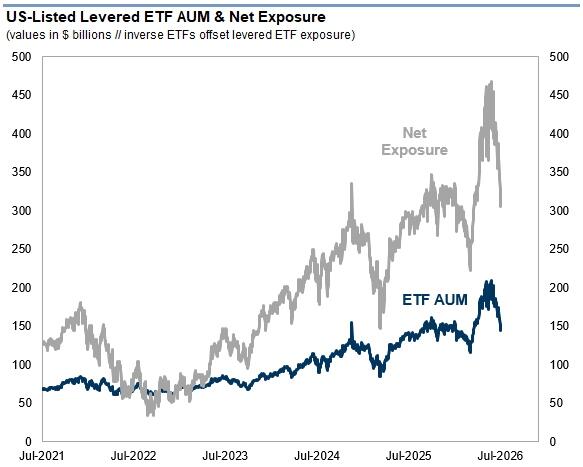
10) By far the most highly sought-after theme over the past two months has been the proliferation of levered/inverse ETFs. As of Wednesday, US-listed levered/inverse ETF AUM hovered just shy of $150 billion, shedding nearly $60 billion since June highs. However, the reversion of AUM has had an outsized impact on net exposure for the complex, which has slid by roughly $170 billion over the past month and now represents $300 billion after Wednesday’s close (yielding an asset-weighted leverage ratio of ~2.1x)… expecting a bounce in these levels as today’s AUM metrics are published today.
Markets At A Glance
US Premarket Movers of Note:
- AMZN US (+12%): Amazon Gains After Fifth Quarter of Cloud Sales Growth
- MPWR US (+8.6%): Monolithic Power Jumps on Strong Results and Guide: Street Wrap
- DXCM US (+7.3%): Dexcom Narrows FY Revenue Forecast
- RIVN US (+4.3%): Rivian Narrows Loss While Rolling Out Lower-Cost EV Models
- NXT US (+3.5%): Nextpower Boosts FY Adjusted EPS Forecast, Beats Estimates
- FSLR US (+3.4%): First Solar 2Q EPS Beats Estimates
- CORZ US (+3.4%): Core Scientific Raised to Buy at Freedom Capital; PT $33
- TSLA US (+2.4%): Tesla Weighs China Unit Sale Ahead of SpaceX Deal, WSJ Says
- TEM US (+2.3%): Tempus AI 2Q Net Revenue Meets Estimates
- COIN US (-4.0%): Coinbase 2Q Total Revenue Misses Estimates: Snapshot
- SYK US (-5.2%): Stryker Slides After FY Organic Revenue Guidance Underwhelms
- AAPL US (-7.1%): Apple Slides After Supply Shortages Hurt Sales Forecast
- RDDT US (-9.0%): Reddit 3Q Revenue Forecast Beats Estimates
- GDDY US (-11%): GoDaddy Shares Fall as Top End of FY Revenue Guide Trimmed
- MTZ US (-15%): MasTec Drops as In-Line Report Follows Strong Results From Peers
- RBLX US (-16%): Roblox Users Miss Estimates on Impact of Safety Measures
FX
- JPY has been in focus following yesterday’s mammoth gains, which sparked intervention speculation. Nikkei sources yesterday said Japan's government and BoJ intervened in the FX market yesterday by buying yen and selling dollars, while desks conducted rate checks. Furthermore, US Treasury Secretary Bessent said the yen has substantially overshot equilibrium, and the US views excess yen volatility as unhealthy, while he added that the yen is very undervalued and that Japan may have intervened in currency markets on Thursday. Add to that, the BoJ kept rates unchanged at 1.00%, which was widely expected as the central bank had just hiked rates at the last meeting in June (see more details below). More recently, USD/JPY slumped some 160 ticks to a trough of 158.34 but has since pared back the move and returned just shy of the 160.00 mark.
- DXY posts modest intraday gains after being pushed lower by the JPY on Thursday, albeit upside is capped by softer crude oil prices. Fresh newsflow for the Dollar has been light this morning, with focus on the BoJ. Analysts at ING suggest that “leveraged funds reported their largest EUR/USD short positions since 2021. That suggests there may still be room for further USD long-squeezing, and we remain reluctant to call the bottom in this dollar selloff just yet.“ DXY trades in a 100.02-100.25 range at the time of writing, vs yesterday’s 99.86-101.07 range.
- EUR is subdued after gaining yesterday on the JPY-induced Dollar decline. EUR/USD resides towards the bottom of a 1.1504-1.1531 range vs yesterday’s rise to 1.1537 from 1.1434. No move was seen on the hotter-than-expected French/EZ prelim CPI, higher-than-expected German unemployment rate, or increase in Italian business and consumer confidence. EUR/JPY found resistance near its 100 DMA (185.18) before waning back closer to 184. GBP is similarly subdued vs the USD within 1.3435-1.3471 after hitting a 1.3477 peak yesterday amid the JPY-induced dollar weakness. UK specifics have been light this morning.
- Antipodeans are flat/mixed with little traction seen from the overall risk appetite across the market, and with metals also showing no clear direction. Overnight, China's official PMIs unexpectedly fell into contractionary territory in July. The weaker-than-expected data reinforced concerns about the pace of China's economic recovery following the Politburo meeting, where Beijing signalled it would continue implementing existing support measures rather than introduce large-scale stimulus. Antipodeans were little moved, with AUD/NZD holding a relatively narrow range between 1.1949 and 1.1985.
FIXED INCOME
- Bid across the board, with Gilts leading as they catch up to the grinding bid seen in peers late yesterday, though benchmarks across the board remain shy of pre-Fed levels, but with Gilts by far the closest, as the dovish points dominated the BoE.
- Gilts at a 87.22 peak, firmer by c. 20 ticks. Just shy of Wednesday’s 87.32 best. As mentioned, the dovish points dominated the BoE, though the overall takeaway is still one of an extended hold with hawkish risks. Today, we get commentary from Chief Economist Pill, and while the views of the hawkish dissenter are well known, it will be interesting to get his take on Governor Bailey’s explicit pushback against moving towards a hike from the press conference.
- Bunds were unreactive to the morning’s data: French HICP and German unemployment. HICP was hotter-than-expected, while Germany’s jobs data saw an uptick in the unemployment rate. EZ Flash HICP printed in line on the headline; core was slightly mixed while the services lifted from the prior. Overall, the print fits with the narrative of the ECB moving towards a September hike.
- Leaving Bunds around 20 ticks off a 124.94 peak, but still with gains of the same amount. A peak that, like peers, is still shy of Wednesday’s 125.12 best. Ahead, the EZ docket is light and thus attention will be on broader macro events and the potential Fed dissenter appearances.
- Ahead of that, USTs are also bid by a tick, peaking at 108-21+, similarly shy of 108-26 from Wednesday. We may see explanations from Fed’s Hammack, Kashkari and/or Logan following the hawkish dissent this week.
- Finally, JGBs picked up heading into the BoJ, with upside emerging around the time of the weak Chinese NBS PMIs, where both Manufacturing and non-Manufacturing moved into contractionary territory. Thereafter, the BoJ itself extended this move in tandem with JPY pressure, as the statement was little changed while the Core CPI forecast was lowered for FY26. Ueda himself sparked some modest JPY action (see FX), though that paled in comparison to yesterday’s intervention moves. For JGBs, little action was seen apart from some modest upside as Ueda acknowledged that market functioning had improved, but did caveat that it had not yet fully recovered.
COMMODITIES
- Crude futures are higher despite a lack of major escalation in the Iran conflict overnight, alongside a sudden quietening in rhetoric from relevant parties. That being said, there were some reports of explosions in Erbil and Sulaymaniyah in Iraq's Kurdistan region, while there was little impact seen after the IRGC announced it targeted a US base in Kuwait. More recently, Iran's IRGC said two offending tankers were hit and stopped, and four offending tankers quickly changed course. Additionally, the IRGC said the Strait of Hormuz is closed, and any transit and movement will be possible only with the coordination of the IRGC Navy. Furthermore, US President Trump announced that the Board of Peace reached a historic agreement for the disarmament of Hamas and all other armed groups in Gaza.
- WTI Sep’26 resides in a USD 82.23-84.32/bbl range while Brent Oct’26 trades in a USD 85.74-87.45/bbl range.
- Precious metals are softer intraday following yesterday’s USD-induced rise, with a lack of major geopolitical updates potentially weighing on the complex. Spot gold resides towards the bottom end of a USD 4,050-4,112/oz range (within yesterday’s USD 4,028-4,120/oz parameter) while spot silver trades in a USD 58.00-59.17/oz range vs Thursday’s 56.94-59.31/oz.
- Base metals are mixed and directionless amid a lack of updates this morning, but with upside in the complex somewhat capped after China's official PMIs unexpectedly fell into contractionary territory in July. The Manufacturing PMI declined to 49.2 from 50.3, below the exp. 49.9, the Non-Manufacturing PMI dropped to 49.0 from 50.2, below the 50.0 forecast, and the Composite PMI fell to 49.3 from 50.6. The NBS attributed the weakness partly to adverse weather and flooding, while analysts also cited subdued domestic demand and persistent pricing pressures. The weaker-than-expected data reinforced concerns about the pace of China's economic recovery following the Politburo meeting. 3M LME copper trades towards the middle of a USD 13,785.00- 13,887.68/t range at the time of writing.
- China's state planner said domestic gasoline and diesel prices will rise by CNY 685 and CNY 655 per tonne, respectively, effective from midnight on July 31, citing higher international oil prices.
- White House NEC Director Hassett said if needed, we will continue measures to lower oil prices, according to CNN.
GEOPOLITICS:
MIDDLE EAST
- Iran's IRGC said, in the early hours of today, two offending tankers were hit and stopped, and four offending tankers quickly changed course. Additionally, the IRGC said the Strait of Hormuz is closed, and any transit and movement will be possible only with the coordination of the IRGC Navy.
- Iranian army announced as part of its 27th phase of operation Thunderbolt, its suicide drones struck fighter jet shelters, satellite communication systems and equipment depots at Kuwait's Ahmad Al-Jaber air base, according to Press TV. Iran's military previously said it used drones to strike US assets in Bahrain's Sheikh Isa air base on Thursday.
- The US and Israel are considering a land blockade of Iran to increase economic pressure, senior Israeli sources told The Telegraph. The plan could involve urging neighbouring countries and regional partners to restrict border crossings and trade. However, some have warned that enforcement would be diplomatically and logistically difficult across Iran’s seven land borders.
- US President Trump posted "Today, the Board of Peace reached a HISTORIC agreement for the COMPLETE DISARMAMENT of Hamas and all other armed groups in Gaza. This is a monumental step toward lasting PEACE and SECURITY", while he added the agreement is a critical step towards Gaza finally being governed by a new Palestinian government that will work closely with the Board of Peace. Furthermore, the agreement will be carried out in carefully structured phases and as disarmament is completed, Israeli forces will withdraw, and the International Stabilization Force will work with a new Palestinian police force to take responsibility for Gaza being safe.
- US officials say they will put Hamas disarmament plan in motion over the next weeks.
- Arab media reported an explosion heard in Erbil, Iraq.
- Israel destroyed a Hezbollah tunnel in southern Lebanon, according to Mehr News,
RUSSIA-UKRAINE
- US President Trump said he has not decided whether he will allow Ukraine to produce Patriot missiles and noted that they are looking at it, according to a phone interview with FT.
- Romania's Defence Ministry scrambled two jets after detecting aerial targets near the border river with Ukraine.
OTHER
- North Korea warned US forces' Japan expansion increases risks of a Korean peninsula clash, according to KCNA.
DB's Jim Reid concludes the overnight wrap
It's hard to know where to start. The huge move up in the KOSPI (>15%) overnight, the huge move in the Yen yesterday or the BoJ?
Given the BoJ meeting ended only an hour ago, with the press conference still to come we'll start in Japan. The central bank left interest rates unchanged while raising their economic growth outlook, reflecting confidence that the economy remains on course for further policy normalisation. This follows last month’s rate increase, which lifted the benchmark interest rate to its highest level since 1995. Board member Hajime Takata dissented, advocating a hike to 1.25% but we expected two dissenters so that was a touch dovish. Takata argued that rising inflationary pressures, driven by external demand shocks and evolving global financial conditions, have increased the upside risks to inflation. In its latest quarterly economic outlook, the BOJ’s board raised its median GDP growth forecasts for both the current and next fiscal years, and now expects the economy to expand by 0.6% this fiscal year. At the same time, the central bank lowered its core inflation forecast to 2.5% from 2.8%, attributing the downward revision primarily to the impact of government subsidy programs. A fall in energy prices also played its part. The forward looking language on inflation and the Yen's impact read a little more hawkish so overall there is something for both hawks and doves. So the press conference will likely be the penalty shoot out here.
The Yen has edged back down -0.78% this morning to 160.77 after a remarkable last 24 hours where it got close to touching both 164 and 158. This was in response to suspected FX intervention that saw the Japanese yen rally sharply early in yesterday’s US session. The yen rose by more than 2% in just half an hour and ended the day up +2.43% at 159.53 per US dollar. The Nikkei reported that Japan’s government and the BoJ had intervened in the FX market and that the US also carried out a rate check on the yen. Shortly after the US close, US Treasury Secretary Bessent told Fox Business that the yen seems “very undervalued” to him. And while the yen spiked, the dollar fell against all G10 currencies yesterday in what was the worst day for the dollar index (-1.01% after -0.52% on Wednesday) since the post-Liberation Day sell off in April 2025.
The other big overnight story is the +16.4% rally in the KOSPI after the tech rebound in the last 24 hours with the Nikkei also up over 4%. This follows Microsoft (+15.51%) having its best day since 2008 following its results the previous evening. This also marked the largest ever single-day increase in any company’s market cap (+$450bn). For perspective, that increase is larger than the value of any company in Europe except ASML. The positive read across from Microsoft’s results for cloud and AI demand helped the NASDAQ to a +2.78% gain. And the Philly semiconductor index (+8.19%) rebounded after its recent woes, its biggest advance since April last year. In turn, that helped the S&P 500 (+1.66%) to its best day in seven weeks, even as most of the index’s constituents declined. The exception from the positive tech mood was Meta (-7.95%) which slumped after its own results.
After the US close, we then got mixed results from Amazon and Apple. Amazon’s shares surged by nearly +10% in extended trading following a +3.90% gain in the regular session as revenue growth in its web services division accelerated to its fastest since 2021 (+37% yoy vs +31.3% est.). The company also raised its 2026 capex projection from $200bn to $220bn. However, Apple’s shares were down about -6% after-hours as it issued a disappointing sales growth forecast for the current quarter (+9% to +11% vs +12% est.). Net net S&P (+0.49%) and Nasdaq (+1.07%) futures are comfortably higher on the overall global tech rebound.
Turning back to Japan, consumer inflation in Tokyo picked up in July, bringing core inflation closer to the BOJ’s target range amid elevated energy costs and the impact of a weaker yen on import prices. Core CPI rose to +1.9% y/y in July, slightly above market expectations of +1.8% and up from +1.6% in June. Meanwhile, core-core CPI, a key measure of underlying inflation closely monitored by the BOJ, increased to +2.0% from +1.9% in the previous month. Headline inflation also strengthened, rising to +2.0% y/y versus expectations of +1.8%, up from +1.7% in June.
Meanwhile, China’s manufacturing sector unexpectedly slipped back into contraction territory in July, while activity in the services sector also weakened, highlighting a broader loss of economic momentum as subdued domestic demand continued to offset resilient export performance. The official manufacturing PMI declined to 49.2 from 50.3 in June, falling short of economists’ expectations of 50.1 and marking its first contraction since February 2026. The non-manufacturing PMI dropped to 49.0 from 50.2, below the consensus forecast of 50.0, while the composite PMI fell to 49.3 from 50.6.
With all that going on, the continued volatility in oil markets was modest by comparison. Brent crude spiked to $93/bbl shortly after we went to press yesterday on news that Iran struck two tankers along the southern route through the Strait of Hormuz which goes along the Omani coast. However, prices then retreated, with Brent crude closing -1.88% at $89.03/bbl and down another -1.7% this morning at around $87.5/bbl. Shipping through the strait has been disrupted but it hasn’t completely stopped, while the US and Iran currently look to be avoiding a move from low-level escalation to all-out war.
The pullback in oil supported a bull steepening in the Treasury curve, with the 2yr yield down (-2.7bps), the 10yr (-0.5bps) little changed but the 30yr (+1.3bps) rising to a new post-2007 high, following on Wednesday’s post-FOMC sell-off. The front-end rally was also aided by sanguine June PCE data, which saw core PCE inflation slow to a +0.1% monthly pace (vs. +0.2% expected). The US data also included a slightly disappointing headline Q2 GDP print (+1.5% annualized vs +2.0% expected), though its downside was driven by imports with domestic demand growing strongly, while the latest weekly initial claims (197k vs 200k expected) pointed to a still solid US labour market. Overnight US yields are 2-3bps lower across the curve.
In Europe, yesterday’s main event was the Bank of England decision, which kept Bank Rate steady for a fifth consecutive time at 3.75%, as widely expected. We did see three of the nine MPC members voting for a hike, up from two in June. However, this vote shift was more than offset by more dovish elements, including signals of MPC confidence that underlying disinflation has continued and comments by Governor Bailey that the BoE wasn’t “edging towards a rate hike”. Markets dialed back expectations for BoE hikes in response, with pricing of a September hike falling from 60% to 30% and 31bps of hikes priced by year-end (-11.4bps on the day). Both 2yr (-11.2bps) and 10yr (-5.1bps) gilts rallied. Our own UK economists continue to expect no change in Bank Rate this year, though risks of a hike would rise the longer that tensions in the Middle East continue. See their full BoE reaction here.
Elsewhere in Europe, sovereign bonds saw a moderate rally, with 10yr bunds -0.7bps lower, while OATs (-2.2bps) and BTPs (-2.9bps) saw larger declines. In terms of European equities, the Stoxx 600 (+0.77%), DAX (+0.60%), CAC (+0.92%) and FTSEMIB (+1.29%) all posted decent advances, though the FTSE 100 (-0.10%) underperformed.
The positive performance in continental assets came as the euro area Q2 real GDP came in at a solid +0.4% qoq in the preliminary reading (vs +0.2% exp.), adding to the sense of the Euro area economy’s resilience in the face of the energy shock. Germany, France and Italy grew by +0.2% qoq, while Spain expanded by +0.7% qoq. Meanwhile, July inflation for Germany came in line with expectations at +2.8% yoy on the EU-harmonised measure, while Spain’s surprised slightly to the upside (+3.8% vs +3.7% expected). We will get the euro area CPI release today, which our economists see tracking at +2.97% headline and +2.53% core, slightly above consensus at +2.9% and +2.4%.
To the full day ahead now, in the US we’ll get the Q2 employment cost index and July MNI Chicago PMI, while in Europe, the highlight will be the July CPI prints for France, Italy and Euro area. Other data releases include Germany’s July unemployment claims, Italy’s July economic sentiment and Canada’s May GDP. Earnings include ExxonMobil, AbbVie, Chevron, Linde, AXA, Engie, and Holcim.
Related Markets
All MarketsMarket data may be delayed. Not financial advice.
How this story developed
Full timelineAlto has tracked this across 26 days of coverage from 1 outlet.
Powered by Gab AI
The Story At A Glance
Reading this article now — analysis appears below
💡 AI analysis provides alternative perspectives on current events