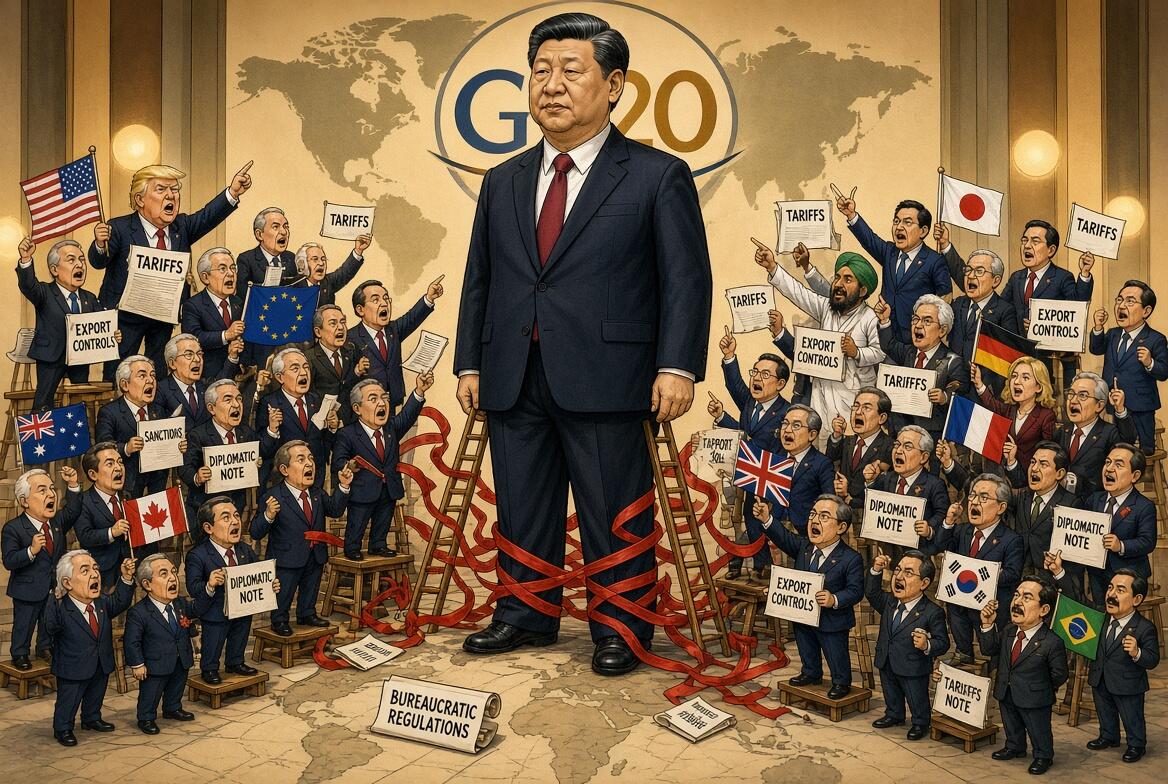
G20 Plans "Death By A Thousand Cuts" For China's Economy
The short version
- Treasury Secretary Scott Bessent held court, telling allies that the only way out of heavy debt loads is growth…
- The latter point is particularly salient as Bessent prosecutes new restrictions against trade with Iran under Operation Economic Outcast.
- China has been Iran’s most important trading partner and the major market for cut-price Iranian oil that had given Chinese industry a cost advantage over buyers observing existing…
- Bessent is now telling allies that they will need to examine their terms of trade with China.
- The “or else” post-script to that message is left unsaid for now, but just ask a Canadian trade negotiator whether the US is developing sharper elbows on this point in recent…
The story
By Benjamin Picton, senior market strategist at Rabobank
The Natural Equilibrium
G20 finance ministers, central bank governors and a handful of high-profile CEOs gathered in Asheville, North Carolina, yesterday. Treasury Secretary Scott Bessent held court, telling allies that the only way out of heavy debt loads is growth, and that they needed to do more to confront China on its structural trade imbalances.
The latter point is particularly salient as Bessent prosecutes new restrictions against trade with Iran under Operation Economic Outcast. China has been Iran’s most important trading partner and the major market for cut-price Iranian oil that had given Chinese industry a cost advantage over buyers observing existing sanctions. Bessent is now telling allies that they will need to examine their terms of trade with China. The “or else” post-script to that message is left unsaid for now, but just ask a Canadian trade negotiator whether the US is developing sharper elbows on this point in recent times.
Even without US pressure, the realization seems to be dawning that Ricardian comparative advantage isn’t actually a utility-maximising strategy when not everyone plays by the rules. Ursula von der Leyen recently said that if trade negotiations do not materially reduce the EU’s record trade deficit with China, the former will need to solve the problem via regulatory tools, including its famed ‘trade bazooka’ anti-coercion instrument. There are no free traders in a foxhole.
There are other signs of deathbed conversions among hitherto free trade evangelists. Australia just imposed new tariffs on Chinese-manufactured train wheels to protect local industry, while an alliance of aluminum extruders in New Zealand are furiously lobbying the government to restrict imports of Chinese aluminum products that they say are being dumped into the local market at prices well below cost of production ever since other markets (the USA, EU and Australia) placed tariffs on those goods to protect their own industry.
Combined with the US’s systematic shutting down of China’s low-cost energy flows from Iran and Venezuela, the promulgation of barriers to entry for Chinese goods is starting to look like death by a thousand cuts for China’s economy. Bessent yesterday pointed to China’s trade surplus equivalent to 1% of global GDP, saying that China is trying to export its way out of a problem of weak domestic demand. Official PMI figures released yesterday showed a slight improvement in China’s manufacturing sector but further deterioration in non-manufacturing, and both sectors remained below the threshold between contraction and expansion.
Unofficial figures released today showed manufacturing expanding and at a faster rate than anticipated by surveyed economists. If that is a true reflection of what is going on, China’s problem with weak domestic demand and a large exportable surplus that needs to be soaked up by demand elsewhere is only exacerbated. If it is not a true reflection, even the export engine is seeing the walls closing in and the official growth target is in serious question.
While recent trade restrictions imposed by other developed nations looks like a meeting of minds, it would be a mistake to interpret this as G20 countries all being on the same page. As much was clear when a number of European finance ministers claimed that they were blindsided by the attendance of Russian finance minister Siluanov and threatened to boycott the ‘family photo’ unless the Russian was excluded. Very clearly, points of divergence remain in the perceived interests of Western nations, which was perhaps highlighted further by a vote in Iceland rejecting a proposal to restart talks on joining the EU even as Canada attempts to deepen EU ties and rebuffed a recent US trade deal to leave itself the option of preferential trade with China.
Another possible point of friction emerged when Bessent seemingly urged the Bank of Japan to get busy raising interest rates even as the Japanese government has been keen to discourage haste. The Treasury Secretary said that he wasn’t going to tell the BOJ what to do, but then indicated that he thought the reflationary policies of Abenomics have run their course and that coordinated intervention in FX markets could only go so far. “I can’t affect the natural equilibrium. What I can do is send a signal and, as I’ve said, I have information that the market doesn’t have.”
Meanwhile, 10-year borrowing costs in Australia just hit their highest levels since 2011 only a day after 10-year yields in France hit their highest level since 2008. 10-year Treasury yields are making new multi-decade highs and the yield on the 30-year is once again threatening the level that it reached before Bessent jawboned it lower by indicating that the Treasury would at least double the size of long end purchases, presumably funded by higher short-end issuance that will require Kevin Warsh and the Fed to provide an assist to keep US borrowing costs relatively low.
In a de-globalising world the West is facing a security-driven imperative to re-industrialize with national debts already at wartime levels and commodity supply chains are increasingly subject to statecraft power plays. These interventions mean that commodity supplies can either be very constrained (as is currently the case for oil and refined fuels) or in a glut, or sometimes both simultaneously in difference parts of the world with new trade barriers preventing goods from flowing and markets from clearing. Glut conditions are currently the case for China-backed nickel processing in Indonesia, and may be the case for US energy in the future if the recent deal to secure control over Venezuelan oil supplies delivers on its promise.
In this environment of market dislocation finding a “natural equilibrium” is going to be harder to do, and it will be impossible for anyone who leans exclusively on models assuming free trade while forgetting to factor in power politics.
Related Markets
All MarketsMarket data may be delayed. Not financial advice.
How other outlets covered this
Compare allAlto found this story at 3 outlets. Same event, different framing — compare the headlines.
How this story developed
Full timelineAlto has tracked this across 9 days of coverage from 3 outlets.
- G20 Plans "Death By A Thousand Cuts" For China's EconomyYou are here
Powered by Gab AI
The Story At A Glance
Reading this article now — analysis appears below
💡 AI analysis provides alternative perspectives on current events