Warsh Faces An "Incredibly Difficult Dilemma" This Week

The short version
- And Some Work Stuff… The 25th anniversary of 9/11 hit hard.
- I only attended a couple of funerals, but will never forget the last moments of some people who I had done business and hung out with for years.
- The whole experience even 25 years later seems surreal, at best.
- I will never forget walking through Central Park to avoid Grand Central (as a potential target).
- Then finally, standing around a TV with “bunny ears” outside a bodega on 1st avenue.
The story
By Peter Tchir of Academy Securities
Never Forgotten! And Some Work Stuff…
The 25th anniversary of 9/11 hit hard. What a scary day! What a scary time. I only attended a couple of funerals, but will never forget the last moments of some people who I had done business and hung out with for years. The funerals were cathartic. The whole experience even 25 years later seems surreal, at best. I will never forget walking through Central Park to avoid Grand Central (as a potential target). Then finally, standing around a TV with “bunny ears” outside a bodega on 1st avenue. Clutching a beer and trying to make sense of the news, as there was no way to reach anyone. Seeing firetruck after firetruck scream down the FDR on the way to ground zero. At first some of the names of the firetrucks made sense. Places in and around NYC. Then you saw them coming in from places like Patchogue (I could be wrong, but that one is somehow emblazoned in my mind). Places in Long Island that had no business being in NYC. I do not know to this day how many of those brave first responders, racing down the FDR, lived to breathe another day. Horrific. Walking in midtown, late in the day, once the “worst” seemed behind us, only to feel the ground shake as #7 came down. We lasted in the city, until the third time the area around us was put on strict alert due to legitimate threats on the Empire State Building. Being one of the first “civilians” being allowed back into the area, not because of anything heroic, but because we were working on a big deal with a re-insurance company in the ground zero area, that “had to get done.” Work did have to continue, but NEVER FORGET!
I am fortunate to work at Academy Securities, where those who enlisted post 9/11 help shape the goals of the firm in terms of creating opportunities for veterans. I am not a veteran, but it has been a pleasure to be involved with the growth of Academy in the almost 10 years that I’ve been here.
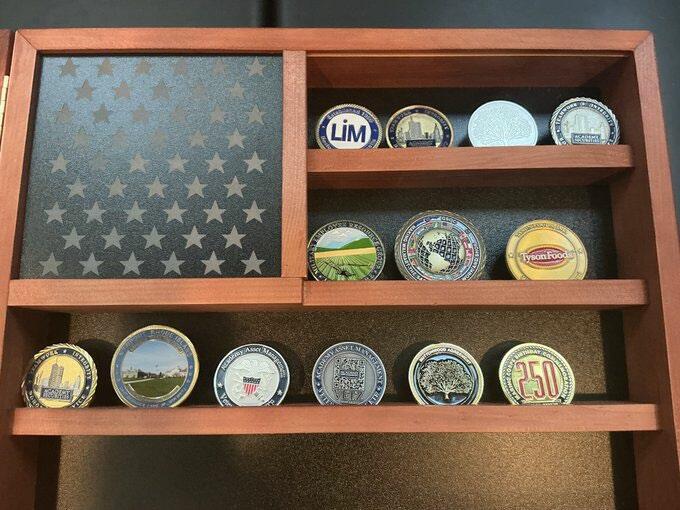
Here is a small selection of the challenge coins I’ve received in my time at Academy. If I’d thought of doing this in advance, rather than spur of the moment, the collection (and photo) would have been better. But the twin towers on the back of Academy Securities’ challenge coin never fail to inspire me, and even more so on this 25th anniversary.
And Some Work Stuff…
We will keep the work stuff relatively short today. Partly because we’ve covered a lot of this already, and partly because we have time to send the latest updates just ahead of the Fed.
Warsh Has A Difficult Job…
While it isn’t Warsh’s decision alone, he faces an incredibly difficult dilemma this week as he tries to steer the Fed into a hike or to a hold.
- The market is 90% pricing in a hike, so it is difficult to push for a hold.
- A hike will likely help the longer end of the yield curve. Which is good.
- With $6 trillion of T-bills maturing in 2026, any hike will immediately increase the amount the country is spending on interest. $15 billion annually. We really don’t benefit much from better longer-term yields. The Federal Reserve balance sheet sits at $6.7 trillion, most funded overnight. Another $15 billion of cost to the country. With interest expense already an issue relative to defense or discretionary spending, a rate hike does not help on that front.
- I find it difficult to imagine President Trump liking the idea, even if it helps the longer end of the yield curve, or that stocks have priced it in.
- While CPI disappointed, it is years of being above trend that make a relatively benign number seem malignant. I continue to wish we could move to alternative data sources sooner than later. The conversation around inflation should be much broader based. While I agree we missed inflation (especially in the aftermath of COVID, I’m not sure fighting old battles is the best way to manage the world’s largest economy).
- I don’t see how hiking rates helps the price of oil, or gasoline, or diesel, when the problem isn’t excess demand, it is supply disruption and a global system of refining that isn’t operating at optimal levels. If everyone was running around willy nilly, “splurging” on gasoline, electricity, and diesel, it might help, but the cost is already impeding demand. How does raising rates help? Maybe it hurts as it makes some projects to generate more oil, gas, and electricity less easy to justify economically?
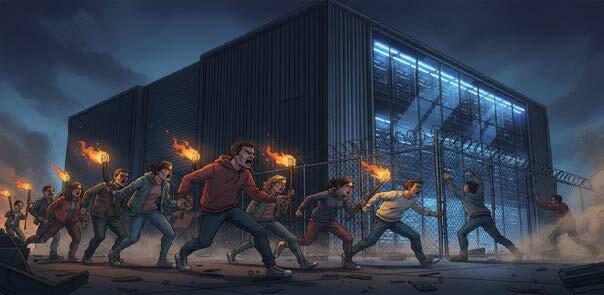
- While we try to figure out whether AI will kill us all in 10 years or not, there is little to slow the “compute” spending. Well, there is an increasingly vocal, largely local, movement against data centers, but they will get built. The companies (who maybe should have been reading the T-Report months and months ago when we first discussed The AI Revolution) are finally starting to do some better outreach. I completely agree with Bessent when he gave them a poor grade on steps taken to persuade communities why they should want, and even embrace, data centers in their area. But there is a 0.00001% chance that 50 bps of hikes slows the compute spend. The compute spend is built on “addressable market shares” that dwarf even current valuations in the compute space. The only way the compute spend slows down is if the perception of the addressable market decreases. That could happen: too much AI slop, Cheap Chinese Compute, etc., but it won’t slow due to rate hikes. Until something changes in the value perception, we are going to see higher memory prices, etc., permeate consumer electronics. So why hike to slow this if it won’t slow it? Btw, here is the AI graphic we use for the AI Revolution and continue to advocate that the industry should spend more time on community outreach; we need AI for many reasons, including national security, but it needs to be “sold” (or better explained to the people than it currently has been).
Warsh has a tough job. I would fight tooth and nail to stay on hold! Not because it would make the President happy (it would). Not because it would help the long end of the yield curve (it won’t), but because hiking won’t help fight the current drivers of inflation, and inflation isn’t high enough to have what I think is a “pre-emptive/fighting past wrongs” hike.
Bessent Is Making His Job More Difficult Than It Is…
Ignoring the fact that periodically Bessent appears to be the spokesperson for the DoW, for Trade, and for the State Department, he is making his own job more difficult. Calling out “Bloomberg Bros” during an interview is curious at best, mildly amusing in the middle, and somewhat preposterous at worst. We addressed this in some reports this week that you may have missed.
Bessent: “Look, if some of the Bloomberg Terminal bros are unhappy with what I’m doing, well, that’s too bad.” pic.twitter.com/j0H7RbmuP0
— Annmarie Hordern (@annmarie) September 11, 2026
As a golfer who is scared of bringing down the wrath of the golf gods, as a trader who goes into panic attacks at the sight of a pen with red ink on the desk, I think he is risking “jinxing” himself (a polite way of saying being far too smug and condescending, when the issues facing markets are much greater than so-called Bond Vigilantes or Terminal Bros). The 3 reports together are comprehensive and worth a read if you missed any of them.
- I Am The House Now compared and contrasted what he is doing with the yen versus the Treasury market. Also highlighted the risk that he may push Japan too far, because they certainly don’t want to be viewed as initiating policy as a puppet of the U.S.
- The 6 Billion Dollar Man was an appropriate follow-up and still has the “bionic running” sounds going through my head. It explained in more detail why he isn’t doing enough, but I do turn mildly bullish on the long end (obviously early).
- For me, last weekend’s Supply & Demand vs Data, where we attempted to create a metric to measure the sheer volume of duration that the IG credit market has been sucking out of the system, is crucial. I do think that the “pleasant” surprise for yields and compute spreads is that more money may currently be set aside for future issuance, without realizing that maybe some of the “future” issuance was done in the summer?
If Warsh does the “wrong” thing (from my view) and hikes, the long end rallies.
Away from that, Bessent is going to have to get serious about addressing the situation (monetizing gold, urging the Fed to do QE, etc.), or get lucky with a smaller IG calendar. Otherwise, we will likely see 5% on 10s over time.
The Gulf States and Iran
There is reporting that the pipeline the Saudis have been using to bypass the Strait has been hit and is currently shut down. We have repeatedly argued that any “new” pipelines (or Middle East Data Centers) are going to be expensive and slow to build because they will need to be “hardened.” Hundreds of miles of exposed pipe is an easy target for drones and rockets and almost impossible to defend.
While the President seems to be indicating that there will be no resolution until after the midterms (consistent with our earliest expectations of when the increased economic pressure on Iran could bring results), he (and the country) faces a couple of realities. Let’s start with diesel.
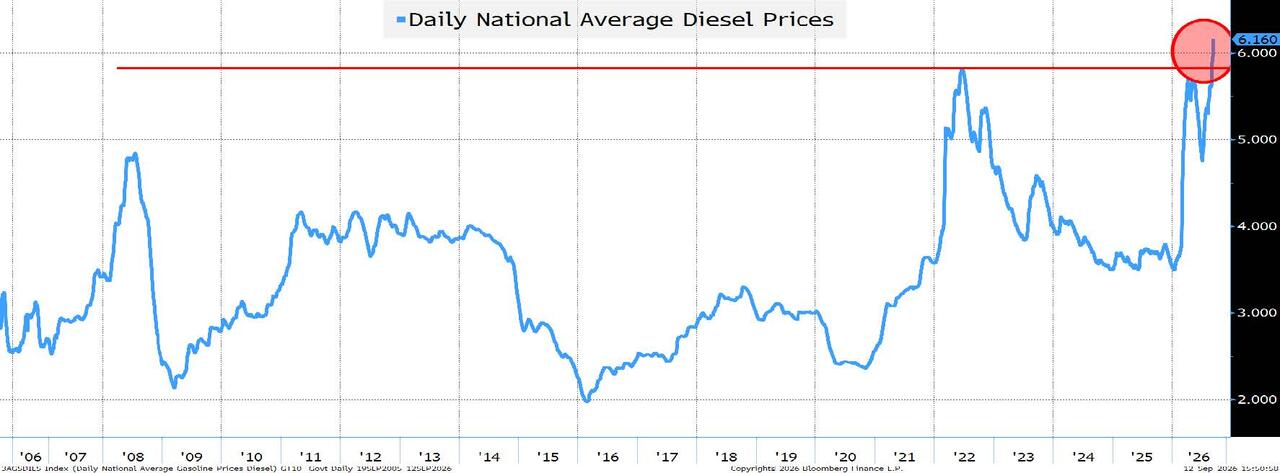
Diesel permeates the economy. It is incredibly important in shipping and agriculture, therefore the entire economy. It is the highest ever. The 2007 “China Commodity Boom” was higher adjusted for inflation, but that was part of an economic boom. My understanding is that U.S. refineries are operating at close to maximum capacity. That some “normal” maintenance shutdowns have been pushed off. Can this continue? Are there risks even to the domestic system, let alone the global system? Ukraine’s attacks on Russia have also worked to push diesel prices higher.
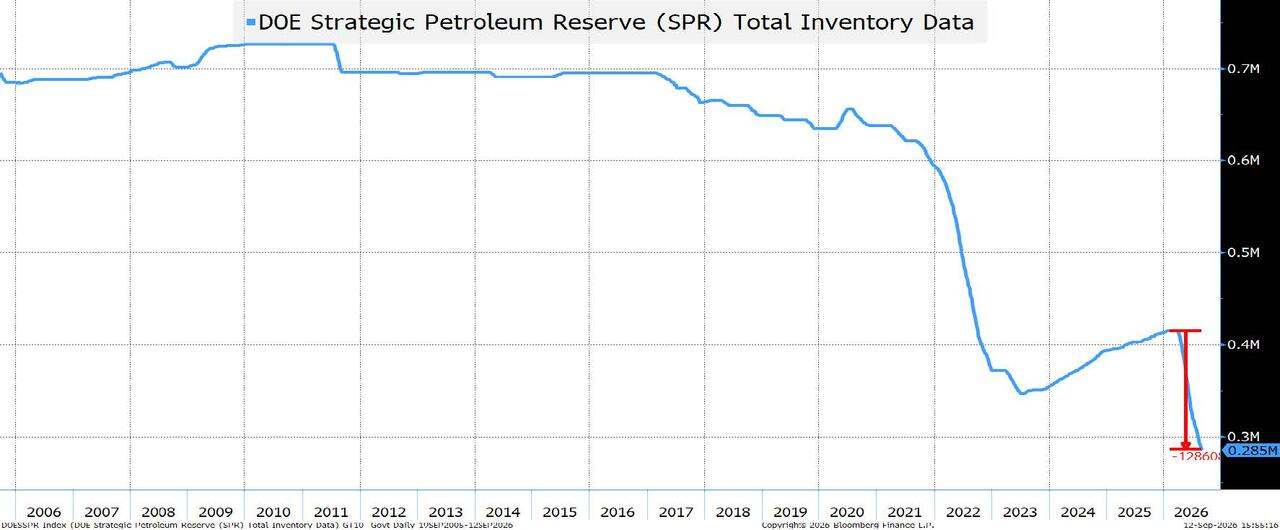
It is far too late to wonder why no one bothered refilling the reserve when we could have.
About 125 million barrels have been extracted from the reserve since the start of the war. We are sitting at 285 million barrels as of last week, but the big question is what is the practical limit to how much can be withdrawn? Without a doubt it cannot be drained to zero and retain structural integrity. How close are we to risking structural integrity? How much more can be released?
During the first phase of the war, globally, reserves played a key role in containing oil prices and ensuring the refining systems were working relatively efficiently.
Without that, this could get much worse, and more quickly than markets have been pricing in.
Bottom Line
Oil and rates seem as important or more important than compute spend to markets and the economy. It is kind of refreshing, but unfortunately the risk/reward in both of those assets is geared towards more pain (higher bond yields and higher oil prices). Yes, I’m mildly bullish bonds (especially compute bonds on an all-in yield basis), but only for a trade, until something changes. The oil situation may get worse far faster than I expected.
Get ready for the Fed and Warsh’s difficult task, Never Forget!
Related Markets
All MarketsMarket data may be delayed. Not financial advice.
Powered by Gab AI
The Story At A Glance
Reading this article now — analysis appears below
💡 AI analysis provides alternative perspectives on current events