If Dems Win The House: Data Centers, Nuclear, Venezuela Oil Deal Likely Targets

The short version
- Debbie Wasserman Schultz (D-FL), who won a crowded primary in August for Florida’s 20th congressional district…
- Lobbyists are already beginning prepwork in anticipation of industry executives being subject to congressional probes or subpoenas, Politico reported.
- Winning back the House would give Democrats the ability to govern committee schedules, set investigative agendas, and leverage subpoenas.
- In the energy sphere, it is unlikely that we we see as hefty a climate focus as in the 117th Congress.
- Any clean energy focus will be instead from an affordability lens, i.e. how an “all of the above” energy approach helps lower electricity costs.
The story
With polling favoring Democrats to win a House majority in the fall and two months till US midterms Nov. 3 (where BofA's Michael Hartnett expects a market rout in case of a Democratic sweep), Dems have begun to preview priorities should they win back the gavel.
Earlier this week, Rep. Debbie Wasserman Schultz (D-FL), who won a crowded primary in August for Florida’s 20th congressional district, vowed if re-elected to help Democrats block Trump’s agreement over Venezuelan oil production. Lobbyists are already beginning prepwork in anticipation of industry executives being subject to congressional probes or subpoenas, Politico reported.
Winning back the House would give Democrats the ability to govern committee schedules, set investigative agendas, and leverage subpoenas. In the energy sphere, it is unlikely that we we see as hefty a climate focus as in the 117th Congress. Any clean energy focus will be instead from an affordability lens, i.e. how an “all of the above” energy approach helps lower electricity costs. Trump energy dealmaking, in particular equity stakes in companies, will also get attention from Democrats.
Below, courtesy of Bridge DiCosmo and James Lucier of Capital Alpha Partners, we look at some of the likely oversight targets for a Democratic House:
Oil companies and profit margins likely back in the spotlight.
When Democrats last had control of the House in the 117th Congress from January 2021-23, the House Oversight environment subcommittee under then-chair Rep. Ro Khanna (D-CA) held at least three hearings in which executives of ExxonMobil, BP America, Chevron, and Shell were called to testify. Much of the scrutiny then was around climate disinformation. This time around, Trump’s ties with the oil sector are likely to be front and center of oversight investigations, with a focus on how companies have benefited from Trump administration regulatory rollbacks. We may see an uptick in Democratic support for windfall profits tax proposals like S.4111, introduced earlier this year by Sen. Sheldon Whitehouse (D-R), though they won’t go anywhere.
Clean energy focus may center on Trump agencies’ efforts to block wind and solar, and pull grant funds.
Renewables focus will likely be in two areas: the Trump administration’s efforts to block or stall wind and solar projects and the ongoing legal fight over termination of Department of Energy (DOE) grants. Specifically, we would anticipate some hearings and letters examining the Pentagon’s and Federal Aviation Administration's reviews of land-based wind projects to ensure they do not impair national security or military operations. A federal district court in Oregon last month ordered the agencies to lift the freeze on such projects. The administration’s clawback of some $7.6 billion in grant funds for clean energy projects is likely to be another core focus for Dems. Language in the Energy Bills Relief Act, H.R. 7977, a massive Democratic energy messaging bill introduced earlier this year, would block the DOE or Environmental Protection Agency (EPA) from terminating future grants based on changes in administration policy direction. Similarly, the Democrats’ energy bill would prohibit “burdensome procedural requirements” for renewable projects.
Venezuela oil deal already drawing Democratic opposition.
The Trump administration’s brokering of a deal for U.S. majority control of 17 Venezuelan oilfields totaling up to 65 billion bbl in proven reserves is already prompting sabre-rattling from Democrats. According to a White House fact sheet, the partnership with private oil producer North American Blue Energy Partners would give the U.S. government off-take rights for 20% of the company’s Venezuela production and right of first refusal for the remaining 80%. “Let’s be clear: this isn’t a win,” Sen. Chris Van Hollen (D-MD) said in a post on X. The fact that the deal would give the U.S. Department of Defense’s Office of Strategic Capital a 35% equity stake in a non-U.S. oil company is likely to emerge as a particular sore spot for Democrats.
More Democratic scrutiny over Trump critical minerals policy.
On one hand, the need to diversify critical minerals supply chains away from China is one of the few areas of general bipartisan consensus in Washington energy policy. However, the disagreements occur over the “how to” part. Trump’s array of investments giving the U.S. government an equity stake in critical minerals companies has not been popular with Democrats. Sen. Martin Heinrich (D-NM) and Rep. Jared Huffman (D-CA) Aug. 7 asked the Government Accountability Office congressional watchdog to launch a probe into the administration taking equity stakes in mining companies. And 54 House Democrats in an Aug. 17 letter to Secretary of State Marco Rubio, Commerce Secretary Howard Lutnick, U.S. Trade Representative Jamieson Greer, and Treasury Secretary Scott Bessent laid out broader concerns with the administration’s critical minerals trade and investment focus. Those concerns range from transparency to labor and human rights to “insufficient congressional oversight,” so expect the latter to ramp up considerably should the Dems win back the gavel.
Democrats’ support for nuclear has widened, but NRC oversight could become a point of contention. Surging electricity demand is shifting Democrats toward stronger support for increasing nuclear capacity. Earlier this year, Illinois Gov. JB Pritzker signed a directive to boost his state’s already large fleet. New Jersey Gov. Mikie Sherrill signed a bill to increase New Jersey’s nuclear generation mix by 2028, lifting a longtime de facto moratorium on new builds in the state. There are a number of nuclear bills introduced this year with bipartisan backing. However, an overhaul of the Nuclear Regulatory Commission (NRC) and subsequent rulemakings aimed at scaling down overly burdensome licensing processes across the nuclear lifecycle have not gone over well with some congressional Democrats. The White House terminated then-Democratic Commissioner Christopher Hanson in 2025, prompting Democratic criticisms about the NRC’s independence. The administration’s proposal to license non-commercial reactors through the Departments of Energy and Defense has also drawn fire from Democratic lawmakers. This could be a focus of oversight hearings. And Democrats have also raised concerns over whether an NRC steering committee gives the White House too much influence over the NRC, an independent commission. Worth noting, the anticipated chair of the House Energy & Commerce Committee, which oversees the NRC, is Rep. Frank Pallone (D-NJ), who earlier this year raised concerns about the agency’s independence.
Expect heightened pressure for regulatory safeguards for data centers.
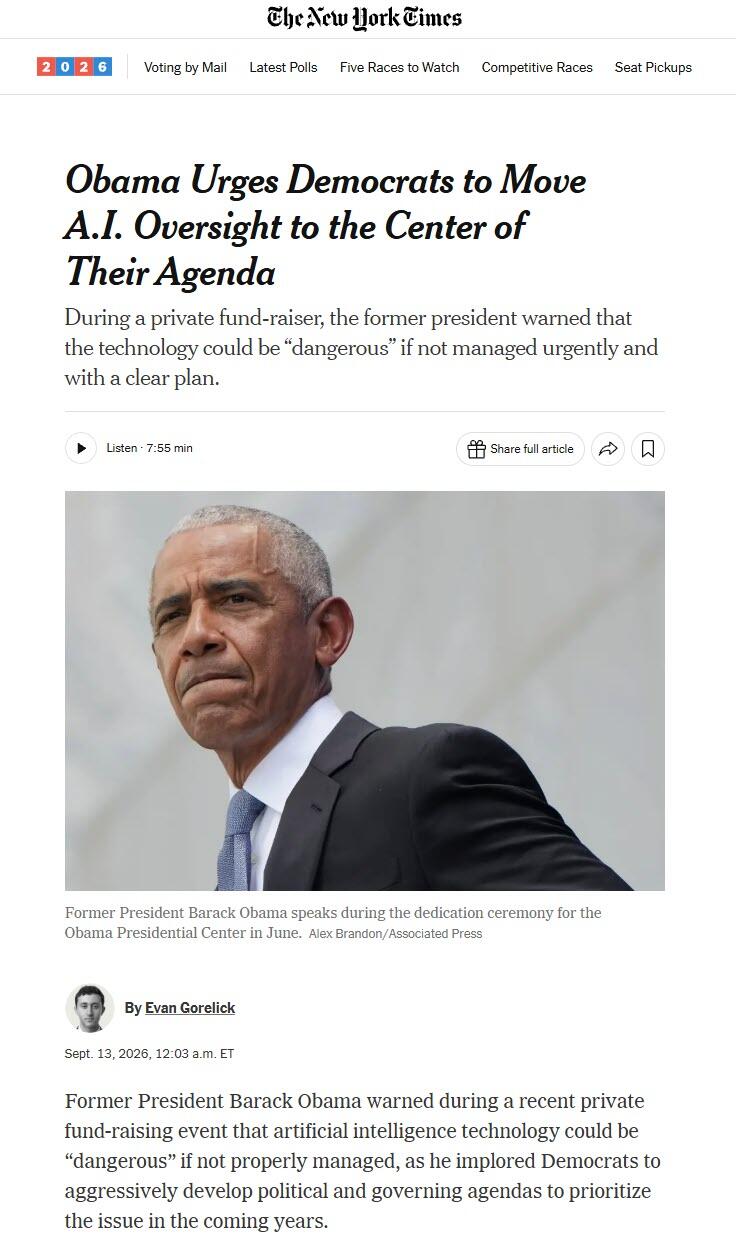
While congressional Democrats are far from lined up behind the idea of a moratorium on data center construction, we would expect a Democratic House to put pressure on the administration for more environmental and regulatory safeguards. The NYT reported that former president Barack Obama urged House Minority Leader Hakeem Jeffries to assemble a clear framework for a public conversation about A.I. policy, and also suggested that candidates running for president in 2028 ought to make A.I. one of their “central agendas” and “have a very clear plan” for responding to safety and economic concerns around the technology.
Elsewhere, a number of Democrats are still backing the Ratepayer Protection Act, H.R. 9340, that would require states to consider establishing a federal standard to ensure data centers foot the bill for costs of grid upgrades needed for their facilities. The bill passed unanimously out of the House Energy & Commerce Committee in July. Others, including likely E&C chairman Pallone, have suggested it doesn’t go far enough. Pallone during a Sept. 3 E&C hearing of the environment subcommittee on Safe Drinking Water Act reauthorization legislation reiterated a call for “real, substantial guardrails” to limit environmental impacts. Pallone backs a moratorium on new data centers absent such guardrails, but has not introduced legislation on the issue. Rep. Alexandria Ocasio-Cortez (D-NY) in June introduced a House version, H.R. 9442, of a Senate bill sponsored by Sen. Bernie Sanders (I-VT), S. 4214. Neither bill has a Republican co-sponsor.
Related Markets
All MarketsMarket data may be delayed. Not financial advice.
How this story developed
Full timelineAlto has tracked this across 2 days of coverage from 1 outlet.
- If Dems Win The House: Data Centers, Nuclear, Venezuela Oil Deal Likely TargetsYou are here
Powered by Gab AI
The Story At A Glance
Reading this article now — analysis appears below
💡 AI analysis provides alternative perspectives on current events