International Energy Agency Is Wrong To Forecast Coal's Demise
The short version
- But, thankfully for American coal states such as West Virginia and the Canadian provinces of Saskatchewan and Nova Scotia—all of which use millions of tonnes of coal every year to…
- However, the world is burning more coal now than ever, reaching a record 8.85 billion metric tonnes annual consumption by the end of 2025.
- Since 2020, annual coal consumption has increased by 1.40 billion tonnes.
- Most of this has come from China, of course, which makes up about 55 percent of global coal consumption (the United States makes up about 5 percent of global consumption).
- In reality, we can’t expect China to slow its coal production anytime soon.
The story
Authored by Tom Harris via The Epoch Times,
Activists would have us believe that coal is a dying energy source. But, thankfully for American coal states such as West Virginia and the Canadian provinces of Saskatchewan and Nova Scotia—all of which use millions of tonnes of coal every year to generate electricity—that is not even remotely true.
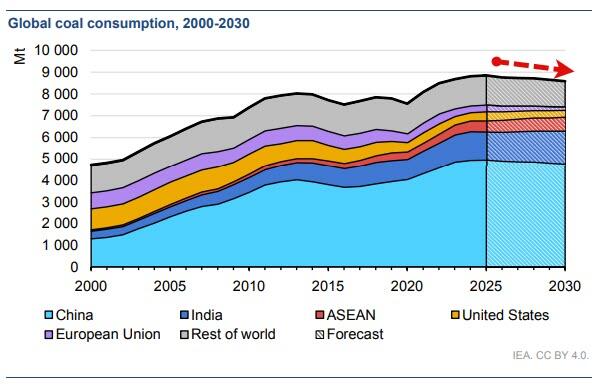
However, the world is burning more coal now than ever, reaching a record 8.85 billion metric tonnes annual consumption by the end of 2025. Since 2020, annual coal consumption has increased by 1.40 billion tonnes.
Most of this has come from China, of course, which makes up about 55 percent of global coal consumption (the United States makes up about 5 percent of global consumption). Although the International Energy Agency (IEA) predicts a decline in demand over the next five years, The Kobeissi Letter more realistically predicts that demand will continue to rise, and points out that “past forecasts of peak coal demand have repeatedly proven wrong.”
A graph on the IEA’s website that illustrates coal consumption (in metric tonnes, Mt) from 2000 to 2022, shows estimates for 2024 to 2026 that seem improbable.
Regardless, the IEA writes that increased demand for renewables is the primary cause for the estimated decline in coal consumption, and that “Global coal demand is expected to effectively plateau over the coming years, showing a very gradual decline through to 2030.” However, they also write that coal use is expected to increase in India by about 3 percent per year and in Southeast Asia by about 4 percent per year up to 2030.
In reality, we can’t expect China to slow its coal production anytime soon. Currently consuming about 3 billion tonnes annually, they will clearly dominate global trends in coal consumption in the years to come. Although the IEA also expects a slow decline in coal consumption in China over the next five years, with the gradual but marked decline of climate change alarmism worldwide and China’s ambition to expand its economy, this prediction doesn’t seem to hold much credibility either.
As The Kobeissi Letter states, coal remains in high demand, and the pipe dream of climate activists to kill coal doesn’t account for the security and convenience that this energy supply affords us. Like nuclear electricity—another power source that is vital to providing electricity for large portions of the world—the fuel for coal-fired power generation can be stored right on a power plant’s site for long periods of time, providing stable energy for society. We especially need coal during deep freezes because natural gas can falter in extreme cold due to “just-in-time” pipeline delivery. Gas flows can slow or freeze entirely, as seen in winter storms Uri (2021) and Elliott (2022), leaving grids vulnerable. And, not surprisingly, in each of these storms, wind and solar delivered very little, and sometimes no power at all, causing millions to lose electricity and causing hundreds of deaths from the cold.
CO2 Coalition energy expert Dick Storm says that “coal is indispensable” and that it is “the lowest cost proven source of primary energy for electricity generation ever in history.” The Canadian province of Ontario, where I live, proved this case well. In 2002, coal provided about 25 percent of the province’s power, and we enjoyed very low electricity rates. But in 2005, then-Premier Dalton McGuinty held a news conference and, pointing to the pile of coal beside him, said it was “old technology” and that, to save the climate and protect the air, Ontario would phase out all coal-fired electricity generation. This made no sense in light of the facts:
1. Coal is not a technology. It is a resource, and the degree to which it causes pollution when burned depends on the technology used to burn it. Reducing carbon dioxide emissions from a coal plant is unquestionably costly, difficult, and of course, unnecessary. Reducing real pollution is often well worth the price and far easier to accomplish with a coal station by using the latest pollution control technology.
2. Seen in a global context, Ontario’s emissions are trivial—one-quarter of Canada’s 1.6 percent of global emissions. So, no matter what one believes about the causes of climate change, McGuinty’s announcement and the province’s painful reduction to 0 percent coal-fired power were merely virtue signalling and showmanship. It had no impact on climate whatsoever.
It did, however, have a huge impact on consumer electricity rates, which, depending on the year, doubled or even tripled as coal was replaced with more expensive power, including a massive expansion of industrial wind turbines. Of course, soaring power rates are politically problematic, so the government decided to hide the increase in the tax base, and today’s rates are merely 50 percent higher than those in 2002. But we all eventually pay for this massive increase, just not directly on our power bill.
Renewable energy has only been able to survive thus far because it is heavily subsidized by tax dollars. These subsidies have, unfortunately, caused coal-fired power stations to be less profitable to operate, by comparison, compounded by the fact that regulations have crippled the industry. It is important to increase our expansion of coal plants, Storm tells us. 800,000 megawatts of new power generation, the equivalent of 80 New York cities, will be needed in the United States in the next 25 years to keep up with demand. This is simply not possible with renewable energy, and although nuclear and other conventional power will be significant players in this, coal will remain a steady, reliable power source to provide us with these vast amounts of power.
Rather than phase out coal, Saskatchewan should build more plants. Since Alberta phased out this important energy source, it will soon come knocking again begging for more power from Saskatchewan’s black gold.
Related Markets
All MarketsMarket data may be delayed. Not financial advice.
How other outlets covered this
Compare allAlto found this story at 3 outlets. Same event, different framing — compare the headlines.
How this story developed
Full timelineAlto has tracked this across 23 days of coverage from 3 outlets.
Powered by Gab AI
The Story At A Glance
Reading this article now — analysis appears below
💡 AI analysis provides alternative perspectives on current events