The AI Economy, Part 1: Looking Beyond The Facade
The short version
- Consider that gasoline prices are nearly $5, crude oil is trading above $100, consumer sentiment is at historically low levels…
- Yet, despite the worrisome headwinds, the US consumer-driven economy continues to expand.
- However, as with a house’s curb appeal, it’s not just the headline data that defines an economy.
- Equally important is its supporting structure.
- Let’s open the door to our economy to better appreciate how AI is currently impacting it and how it may change in the future.
The story
Authored by Michael Lebowitz via RealInvestmentAdvice.com,
The US economy’s curb appeal looks great. Consider that gasoline prices are nearly $5, crude oil is trading above $100, consumer sentiment is at historically low levels, and mortgage and other interest rates have remained relatively high. Yet, despite the worrisome headwinds, the US consumer-driven economy continues to expand. However, as with a house’s curb appeal, it’s not just the headline data that defines an economy. Equally important is its supporting structure. Let’s open the door to our economy to better appreciate how AI is currently impacting it and how it may change in the future.
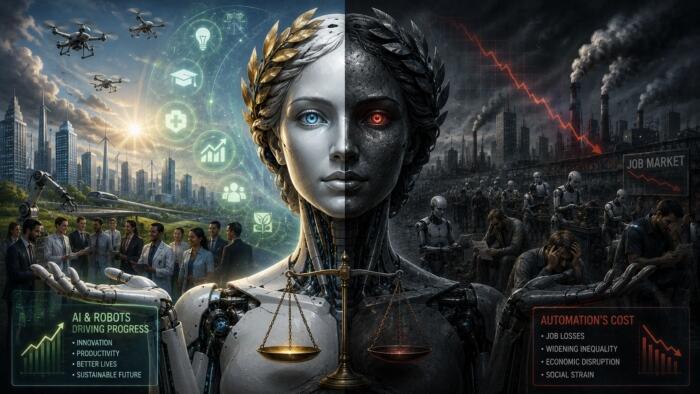
The question we explore here is whether the AI investment boom is genuinely broadening this country’s economic footing or weakening the labor force, the foundation of the economy.
We separate the article into two parts. Part one is the optimistic case: an AI-induced, productivity-led economic boom in which the benefits spread quickly to society. Part Two will address a more bearish outlook: the possibility of a large gap in the distribution of AI’s productivity benefits, accruing to corporations much more quickly than to employees.
AI Spending Drives GDP
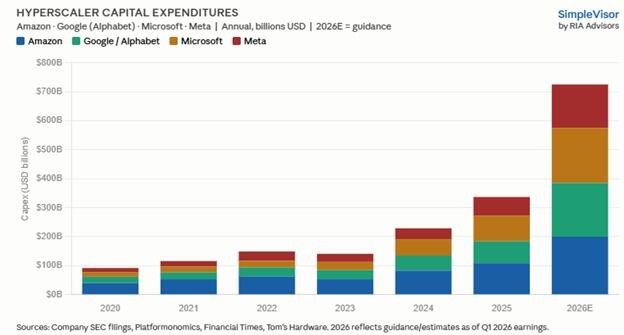
The amount of capital flowing into AI infrastructure development and thus GDP is enormous. As shown in the graph below, the capital expenditures (Capex) of just four companies, Amazon, Google, Microsoft, and Meta, are now over $700 billion annually, roughly 7x what they were five years ago. Based on the 2026 Capex expectations, a third of GDP growth could come from the four companies.
The AI buildout extends well beyond the four balance sheets noted above. Every dollar of Capex spent by the large hyperscalers creates demand across a wide supply chain. For example, construction firms are building data center campuses the size of small cities, utility companies are scrambling to add generation capacity, domestic semiconductor producers are ramping up output, and fiber optic and networking suppliers have multi-year order backlogs. The electrical grid is facing its first sustained demand growth in two decades, driven almost entirely by data center power requirements, which are projected to more than double by 2030.
Historical Context
The scale of today’s AI buildout has historical precedent. For instance, the railroad expansion of the mid-1800s involved more extreme infrastructure investment, with railway Capex estimated to have consumed as much as 10-20% of GDP at its peak. A more recent and appropriate comparison is the telecom buildout of the late 1990s, when Capex peaked at roughly 1.0-1.2% of US GDP. Today’s AI infrastructure spending by just the four companies has recently surpassed that telecom figure.
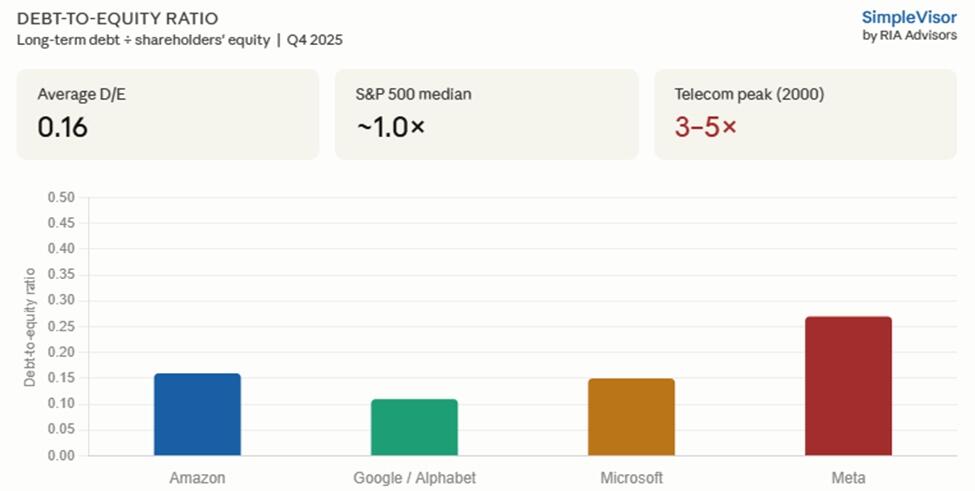
But unlike the debt-fueled telecom boom, today’s AI spending has thus far been funded almost entirely by the cash and cash flows of extremely profitable corporations. While the composition of funding is shifting from cash and free cash flow to debt, the companies noted above have debt-to-equity ratios well below the S&P 500 average and significantly lower than during the telecom buildout. Moreover, earnings from other highly profitable business lines will continue to provide them with substantial cash for investment.
The Consumer Is Resilient But Running Thin
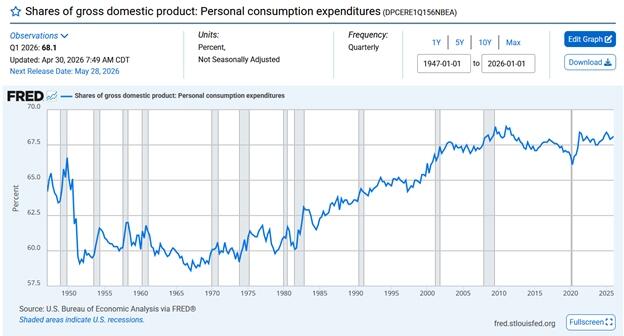
While AI spending is tremendous and boosting the economy, some argue that it is masking weaknesses in consumer spending, which is the most important contributor to economic growth. The graph below shows that consumer spending accounts for about 67% of GDP, as it has since 2001. There has been no discernible change over the last few years since the advent of AI.
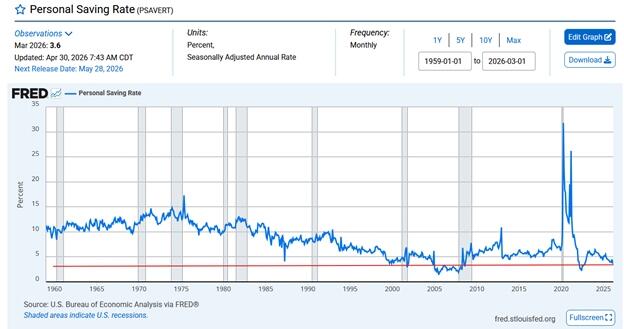
While the recent contribution of consumer spending has not changed meaningfully, its sustainability is a key factor driving future growth. While consumption is holding, there are signs that the means to spend are deteriorating. For instance, the personal savings rate has fallen to near its lowest level since 1960, as shown below. This suggests that a growing share of personal consumption is being funded by drawing down savings rather than by current earnings.
Such behavior is not unusual during periods of strong employment, as consumers spend more when they are confident about their job and wage prospects. That said, a low savings rate is a yellow flag, but it has coexisted with healthy economic expansions before.
The more important gauge of future consumption is wages, which leads us to the labor market
A Churning Labor Market
AI will swallow up jobs, some pessimists say. Thus far, that is not the case. For instance, in 2025, nearly 55,000 of 1.17 million layoffs were directly attributed to AI, according to Challenger, Gray & Christmas. Other estimates peg the number higher at 200,000–300,000 positions in 2025. While that estimate is more concerning, it is only about 0.15–0.20% of total nonfarm employment.
Looking forward, the outlook gets murky. Goldman Sachs has a dire outlook with 300 million jobs globally at risk. But that only tells half the story. The World Economic Forum (WEF) estimates that AI will create 170 million jobs globally.
There is no doubt that AI will have significant impacts on the economy, labor market, and many individuals. Prior innovations are proof. To wit, about two-thirds of US jobs in the 1940s no longer exist. The replacement jobs were enabled by new innovations.
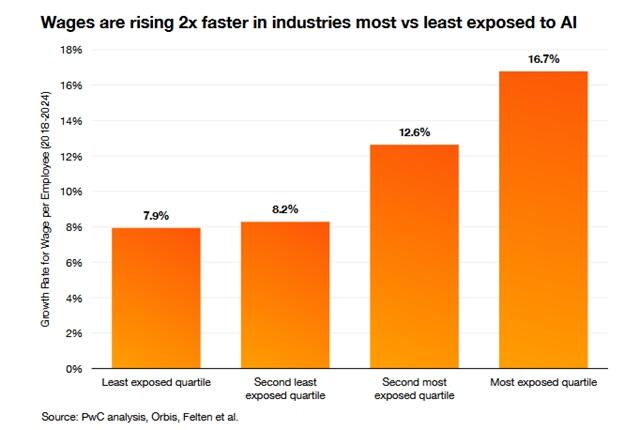
While the future remains uncertain, the past relationship between job growth, wages, and productivity is encouraging. As we share below, PwC claims “wages are rising 2x faster in industries most vs least exposed to AI.”
Productivity Gains Will Spread
Economic growth and wage growth are a direct function of productivity. Productivity measures the amount of leverage an economy can generate from its two primary inputs, labor and capital. Without productivity, an economy is solely reliant on two limited inputs. Thus, without productivity growth, economic growth is unlikely over the long run.
Therefore, it’s critical to discuss how much productivity AI will generate and how it will be distributed. The first part, how much, is nearly impossible to assess today. That said, PwC estimates that productivity growth has nearly quadrupled in AI-exposed industries since 2022. Further:
Is AI really the cause of this surge in productivity? We can’t prove causation with certainty, but we do know that revenue growth in AI-exposed industries accelerated sharply in 2022, the year that the launch of ChatGPT 3.5 awakened the world to AI’s power. Since then, as companies have raced to leverage this technology, the value created in industries best positioned to use AI has skyrocketed. In the space of two years, industries most able to use AI have changed from productivity laggards to leaders, suggesting that investments in AI are paying off. AI’s promise is proving to be real, and we are only in the early days of AI adoption.
Regarding the distribution of productivity, some pessimists argue that AI’s productivity gains are flowing overwhelmingly to high-income knowledge workers. While that is currently true, that has also been the case with every major technology wave in its early phase. Factory automation initially benefited capital owners. Personal computers initially benefited white-collar workers. The internet initially benefited the educated and connected. But over time, prices fall, adoption rates grow, and the benefits spread across the entire workforce.
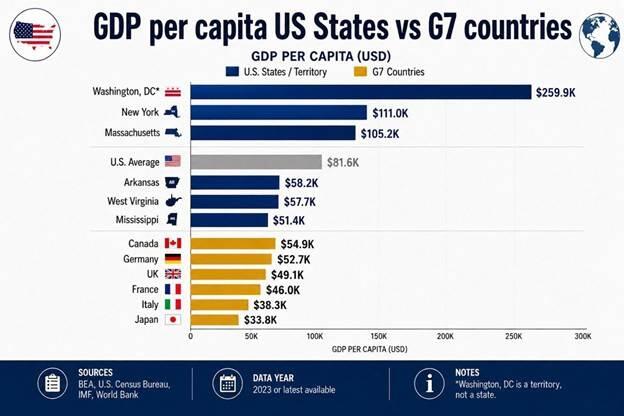
History’s verdict is consistent: the benefits start narrow and ultimately spread wide across the economy. As we share in the graphic below, as a result of the US being a global leader in innovation, our poorest states, Mississippi, West Virginia, and Arkansas, have a similar or higher GDP per capita than other large nations.
Summary
While still early in the AI revolution, the economic data points to genuine economic momentum. Whether AI productivity benefits can become more broadly based across the economy is the question that Part Two of this article addresses.
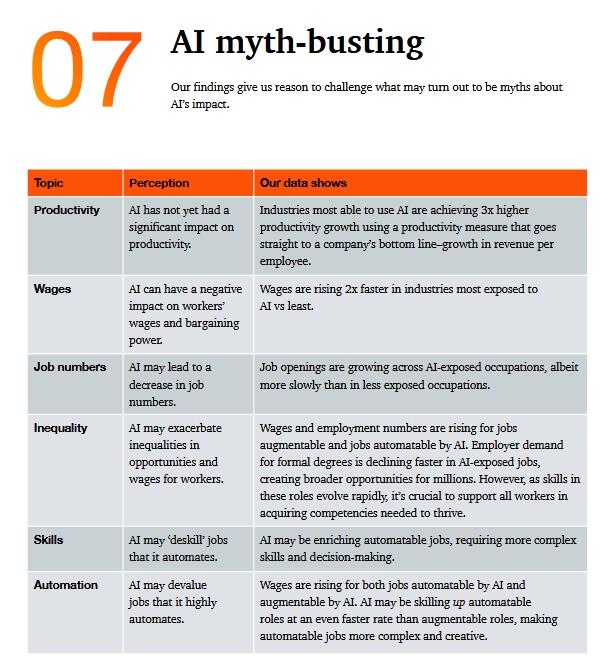
Before we present the other side, we will leave you with a PwC table that addresses concerns about productivity and the labor market.
Related Markets
All MarketsMarket data may be delayed. Not financial advice.
Powered by Gab AI
The Story At A Glance
Reading this article now — analysis appears below
💡 AI analysis provides alternative perspectives on current events