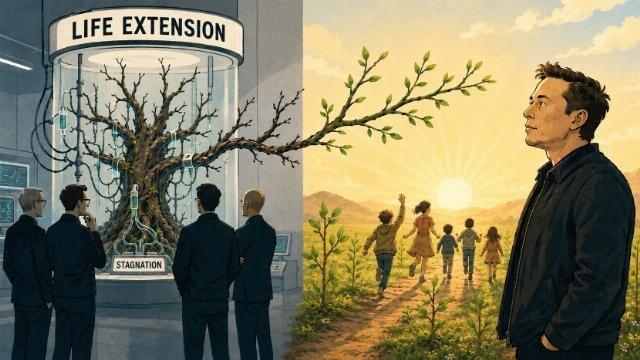
Elon Musk's Answer To Mortality
The short version
- Elon Musk - the wealthiest of them all and arguably the most publicly concerned with humanity’s long-term survival - has consistently argued almost the opposite.
- Most people form their core worldview relatively early in adulthood and rarely change it fundamentally.
- If those individuals never leave positions of influence, society risks locking one generation’s assumptions permanently into its political, economic, and cultural institutions.
- In Musk’s view, mortality is not merely a biological limitation; it is one of the mechanisms by which civilizations renew themselves.
- What makes his position especially interesting is that it is not rooted in scientific pessimism.
The story
Authored by David DeMay via AmericanThinker.com,
Ask most Silicon Valley billionaires what they think about death, and you’ll get some version of a declaration of war. Peter Thiel has funded life-extension research for years and has spoken openly about wanting to “fight death.” Jeff Bezos, Sam Altman, and a growing circle of biotech-backed investors have likewise poured billions into companies pursuing not merely longer life, but the possibility of radically slowing or even ending human aging.
Elon Musk - the wealthiest of them all and arguably the most publicly concerned with humanity’s long-term survival - has consistently argued almost the opposite.
Speaking at the World Economic Forum Annual Meeting in conversation with Larry Fink, Musk remarked, “There is some benefit to death.”
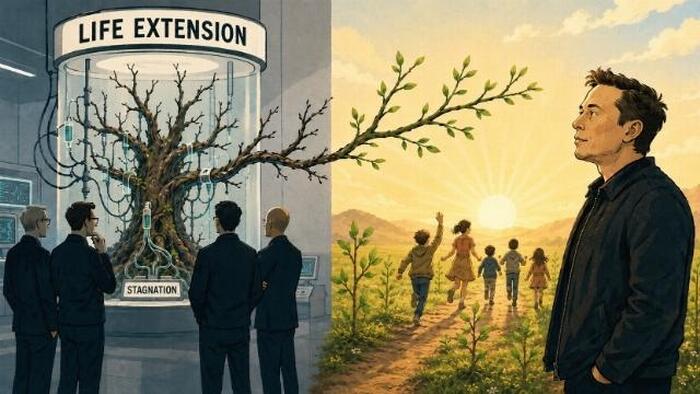
He warned that dramatically extending human lifespans could lead to “an ossification of society,” leaving institutions increasingly rigid and ideas “stultifying” as the same generation remained in power indefinitely.
His reasoning is straightforward. Most people form their core worldview relatively early in adulthood and rarely change it fundamentally. If those individuals never leave positions of influence, society risks locking one generation’s assumptions permanently into its political, economic, and cultural institutions. In Musk’s view, mortality is not merely a biological limitation; it is one of the mechanisms by which civilizations renew themselves.
What makes his position especially interesting is that it is not rooted in scientific pessimism. During the same discussion, Musk suggested the opposite: Aging is probably a solvable scientific problem. He noted that virtually every tissue in the body appears to age in parallel.
“You’ve never seen someone with an old left arm and a young right arm,” he observed, arguing that such synchronized aging hints at a common biological mechanism. Once that mechanism is understood, he speculated, the solution may appear surprisingly obvious.
The tension is striking. Musk appears to believe that aging is likely to become an engineering problem with an engineering solution. Yet he has shown remarkably little interest in dedicating his own fortune to solving it. His hesitation is philosophical rather than technological: He questions whether dramatically extending individual lifespans would ultimately strengthen or weaken civilization.
That places him in sharp contrast with many of his peers. For much of Silicon Valley, mortality has become the next great engineering challenge—a problem to be solved through biotechnology, artificial intelligence, and unprecedented capital investment. Musk has instead argued that society should be at least as concerned with preserving its capacity for renewal as with extending individual lives.
A second priority reinforces that distinction. Rather than focusing primarily on longevity, Musk has repeatedly argued that declining birth rates pose the more immediate civilizational threat. A society may someday conquer aging entirely, he has suggested, yet still decline if it ceases to produce enough children to replace itself. Extending the lives of existing people cannot compensate indefinitely for a shrinking number of new ones.
Taken together, his views form a coherent hierarchy of priorities. Aging is real and probably solvable, but not necessarily the most urgent problem. Indefinite life extension carries the risk of social stagnation. Declining fertility, by contrast, threatens the long-term continuity of civilization itself.
Whether one agrees with that hierarchy is another question. What is difficult to ignore, however, is that Musk’s own life reflects the priorities he describes. While many technology leaders have invested extraordinary sums in extending the human lifespan, Musk has become the father of fourteen children and has consistently argued that building the next generation matters more than indefinitely prolonging the current one.
That does not prove his family is a deliberate philosophical statement, nor does it reveal his private motivations. But it does reveal a notable alignment between his public arguments and his personal choices. Rather than devoting his fortune primarily to extending his own life, he has devoted a remarkable part of it to creating the generation that will outlive him.
Silicon Valley’s prevailing instinct has been to treat mortality as an engineering problem: extend the individual life for as long as possible. Musk has consistently offered a different answer. He sees death as one of the mechanisms by which societies remain capable of renewal, while viewing falling birth rates as the more immediate threat to humanity’s future. Whether that philosophy ultimately proves correct remains to be seen. What is already clear is that his actions are unusually consistent with his words. In that sense, Musk’s answer to mortality is not another decade of life. It is another child.
Related Markets
All MarketsMarket data may be delayed. Not financial advice.
How other outlets covered this
Compare allAlto found this story at 2 outlets. Same event, different framing — compare the headlines.
How this story developed
Full timelineAlto has tracked this across 2 days of coverage from 2 outlets.
- Elon Musk's Answer To MortalityYou are here
Powered by Gab AI
The Story At A Glance
Reading this article now — analysis appears below
💡 AI analysis provides alternative perspectives on current events