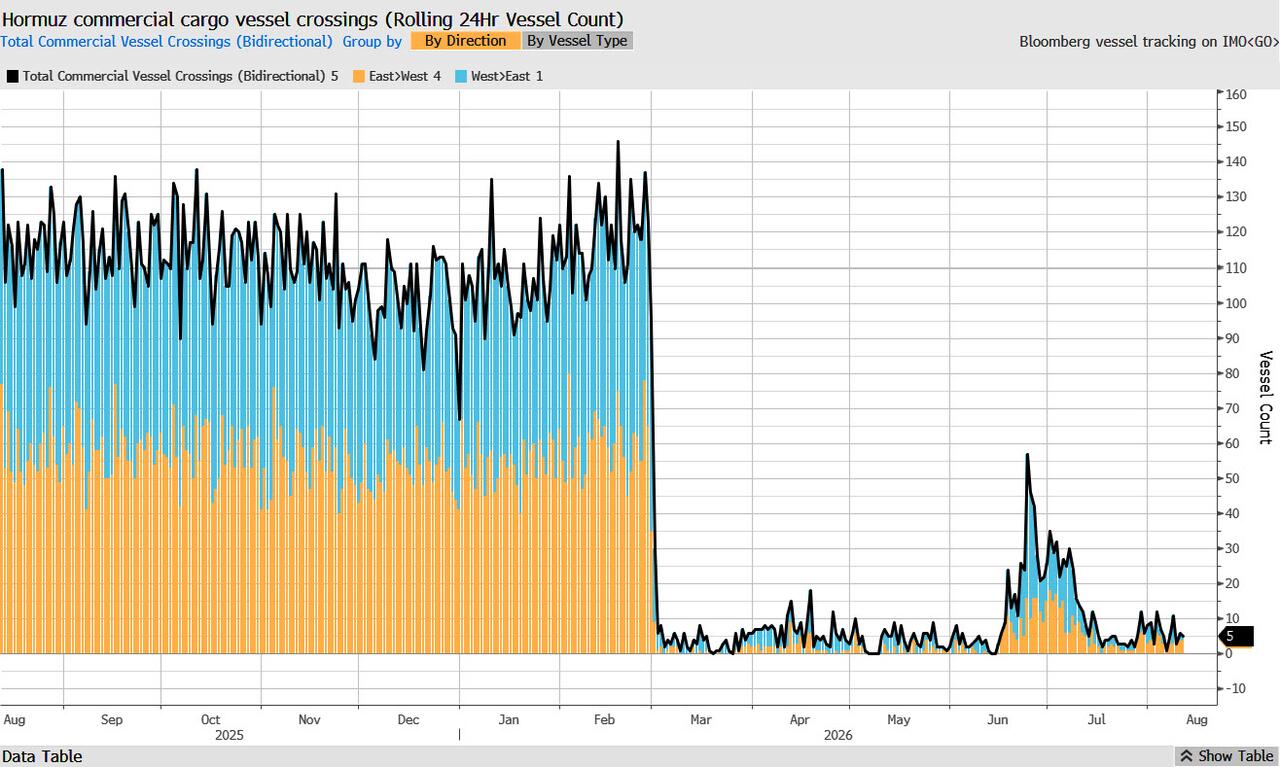
Hormuz Traffic Sank To Just Six Vessels Monday
The short version
- As OilPrice notes , on Monday, only six commodity vessels transited the Strait of Hormuz in either direction, down from 11 ships in the latest 10-day average…
- Four commodity vessels moved inbound into the Persian Gulf via the Strait and two others exited outbound, the data showed.
- Bloomberg data reveal a similar picture, only instead of 2 ships exiting, Bloomberg has only 1, bringing the total Monday commercial crossings to 5.
- The inbound movement of commodity ships included two empty product tankers, while a small LNG carrier and a tanker shipping residual fuel exited the Persian Gulf with energy…
- At Bab el-Mandeb, the chokepoint between the Red Sea and the Arabian Sea, traffic remained unchanged on Monday compared to the 10-day average of about 24 vessels transiting the…
The story
Vessel traffic at the Strait of Hormuz continues to decline as last week’s hopes of negotiations of a U.S.-Iran deal began to fade, yet again.
As OilPrice notes, on Monday, only six commodity vessels transited the Strait of Hormuz in either direction, down from 11 ships in the latest 10-day average, according to shipping data from Kpler cited by Reuters on Tuesday. Four commodity vessels moved inbound into the Persian Gulf via the Strait and two others exited outbound, the data showed.
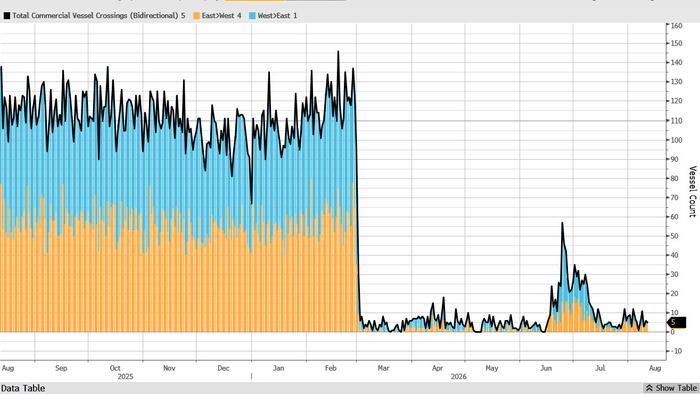
Bloomberg data reveal a similar picture, only instead of 2 ships exiting, Bloomberg has only 1, bringing the total Monday commercial crossings to 5.
The inbound movement of commodity ships included two empty product tankers, while a small LNG carrier and a tanker shipping residual fuel exited the Persian Gulf with energy products en route to buyers.
At Bab el-Mandeb, the chokepoint between the Red Sea and the Arabian Sea, traffic remained unchanged on Monday compared to the 10-day average of about 24 vessels transiting the area.
Traffic at the Strait of Hormuz has slumped to the lowest in more than two months as security concerns have intensified with recent attacks on ships and persistent threats to shipping in the region.
After a brief respite between the middle of June and early July, when traffic at Hormuz rose with the tentative opening of the chokepoint as part of the now-dead U.S.-Iran memorandum of understanding, traffic of all vessels, including commodity carriers, plunged to a two-month low as of the end of July.
The security situation has deteriorated in the past two weeks, with Iran determined to exert control over vessels transiting the Strait of Hormuz and the Iran-aligned Houthis threatening Saudi-linked shipments in the Red Sea and the Bab el-Mandeb Strait.
Traffic at Hormuz needs to recover to nearly pre-war levels of around 80 to 100 ships per day just to stabilize energy markets, Bank of America warned earlier this week. Only around 5 to 10 ships per day are currently passing through the Strait of Hormuz, compared with roughly 140 before the war, Francisco Blanch, Bank of America’s head of commodities and derivatives research, told CNBC on Monday.
Related Markets
All MarketsMarket data may be delayed. Not financial advice.
How other outlets covered this
Compare allAlto found this story at 6 outlets. Same event, different framing — compare the headlines.
- ZeroHedgeTanker Data Contradicts US Claim That Middle East Oil Flows Have Normalized14 days ago
- Google NewsHormuz shipping traffic falls to one-week low amid hostilities - Reuters15 days ago
- AxiosU.S. officials believe sanctions could hurt Iran more than bombsabout 1 month ago
- BreitbartHormuz Traffic Falls to Two-Month Low as Iran Attacks Shippingabout 1 month ago
- APIran’s president says $6B in frozen assets in Qatar to be released as US talks challengedabout 2 months ago
- The Guardian — WorldMiddle East crisis live: US talks with Iran set to continue despite Iranian walkout2 months ago
How this story developed
Full timelineAlto has tracked this across 25 days of coverage from 6 outlets.
- Hormuz Traffic Sank To Just Six Vessels MondayYou are here
Powered by Gab AI
The Story At A Glance
Reading this article now — analysis appears below
💡 AI analysis provides alternative perspectives on current events